How to Work on Your Business When You're Tired After Work
Want to work on your business when you're tired after work? Decide in daylight, match tasks to your energy, keep tired nights small and protect your sleep.
Last updated: 13 October 2026
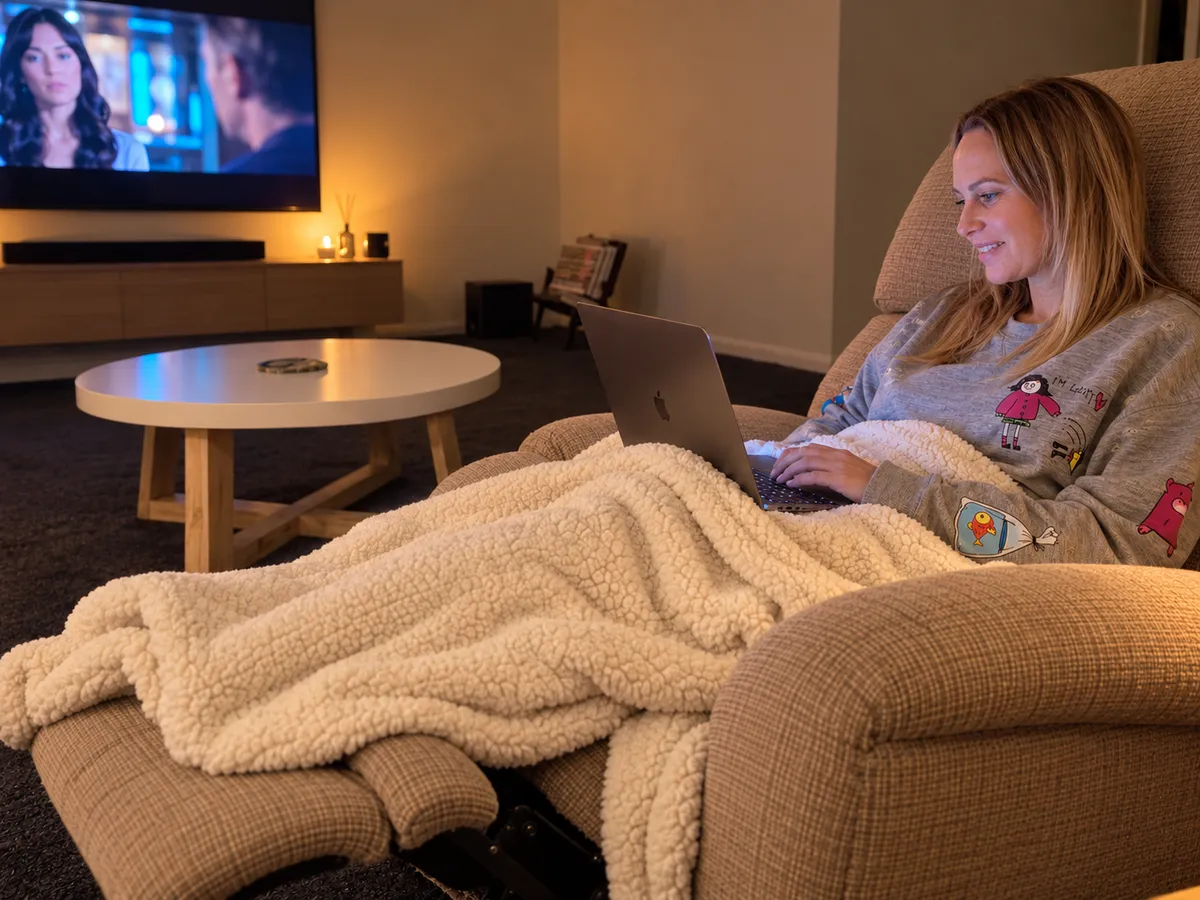
It's 8pm. I'm in the same lazy boy chair, feet up, laptop on my knees, with a movie playing in the background that I've seen at least twice before. That's my office for the business.
I'll be honest: some of that is a trick on myself. If the movie's on, it doesn't feel like work. I get a bit of the relaxing and a bit of the building, and I genuinely love that I get to do both.
Here's the short answer if you're reading this with whatever energy is left. You can work on your business when you're tired after work, but not by trying harder at 8pm. Decide what you'll do earlier in the day, match the task to the energy you'll actually have, keep tired nights small, and protect your sleep so tomorrow night isn't worse.
Below is how I plan my week around which days drain me, the bedtime rule I don't break, and one small step you can take tonight.
Why are you so exhausted after work, even when you sat at a desk all day?
You're exhausted after work because your job has already spent your attention and your decisions, not just your physical energy. Desk work drains you in a different way: hundreds of small interruptions and choices, each one tiny, all of them adding up.
Microsoft's 2025 Work Trend Index puts numbers on it. Its data shows people using Microsoft 365 are interrupted roughly every two minutes during core hours by a meeting, email or chat, and in its survey of 31,000 knowledge workers across 31 countries, including New Zealand, 48% of employees said their work feels chaotic and fragmented (Microsoft's 2025 report on the infinite workday).
Then you come home to the second shift: dinner, homework, bath, bedtime. By 8pm you haven't failed at energy. You've already used most of it on everyone else. That's the starting point for a realistic plan, not a reason to give up.
Is it normal to be too tired to work on your business after work?
Yes, it's normal, and it doesn't mean you're not cut out for running a business. Most people building something on the side of a full-time job feel this. They just don't talk about it.
There are far more of us than you'd think. In my own Skool community, From Job to CEO: The Experiment, and in the other business groups I'm part of, plenty of people are building a business around a 9-to-5. But people rarely advertise it at work, so it's easy to assume everyone else has endless evening energy. Page one of Google for this question is full of Reddit threads with 50-plus comments from people saying the same thing: I get home, I'm wiped, the business waits.
Where you work matters too. The same Microsoft report points to Microsoft Research findings that remote workers often see evening hours as a productive window for quiet catch-up, while hybrid workers are more likely to experience that same time as stressful.
That matches my week exactly. Your energy isn't one fixed number. It changes by the kind of day your job gave you.
How do you plan your business work around your tired days?
Plan your business week around which work days drain you most, and give those evenings only the easy jobs. I stopped expecting the same output from every night, and my week got calmer straight away.
I'm in the office on Mondays and Tuesdays. Those days start with the school rush and a drive, then I'm "on" all day, talking to people. I deliberately book most of my meetings for office days, so my work-from-home days have fewer interruptions and far more headspace.
The trade-off is that I know Monday and Tuesday nights will be flat. So those nights get a short list of easy business jobs, and the thinking work waits for a home day.
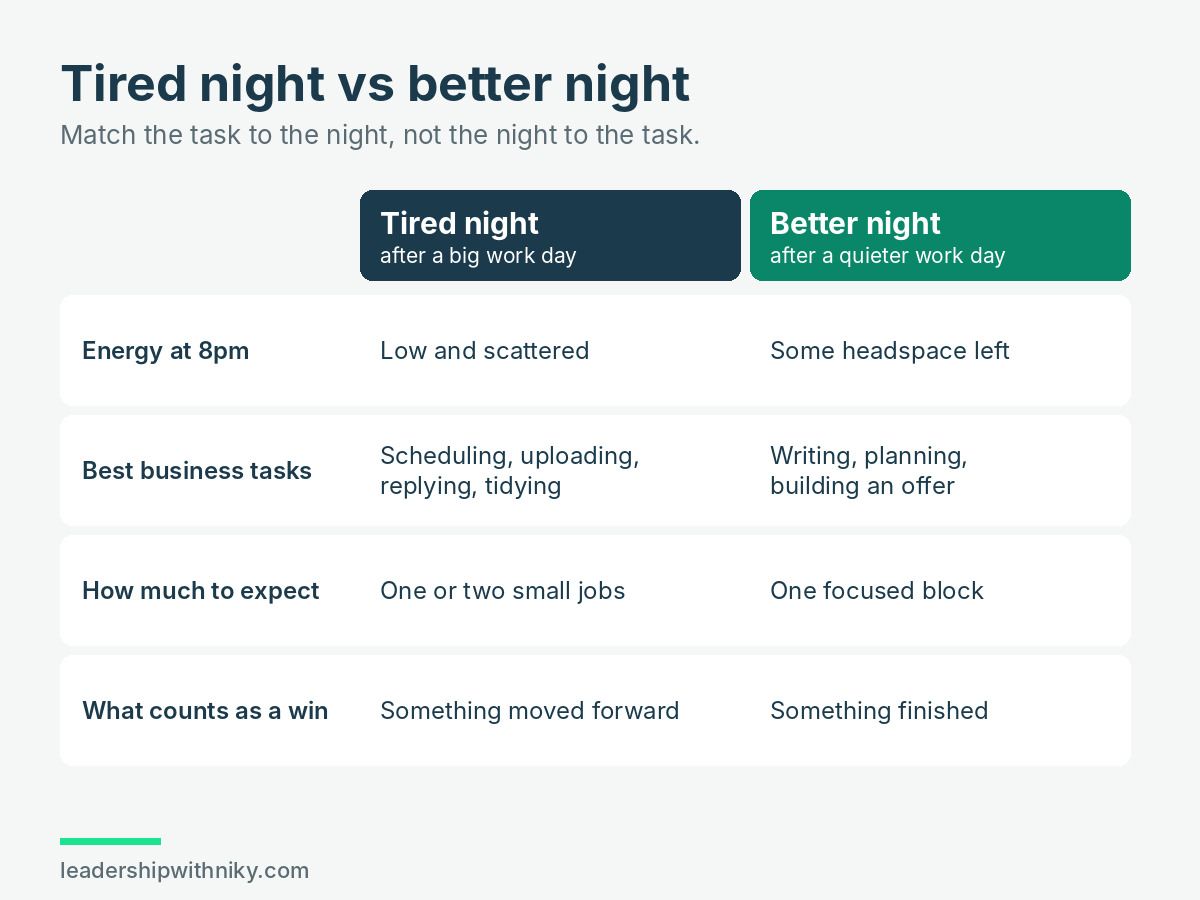
Tired night (big work day) | Better night (quieter work day) | |
|---|---|---|
Energy at 8pm | Low and scattered | Some headspace left |
Best business tasks | Scheduling, uploading, replying, tidying | Writing, planning, building an offer |
How much to expect | One or two small jobs | One focused block |
What counts as a win | Something moved forward | Something finished |
Match the task to the night, not the night to the task.
Should you decide what to work on before the evening?
Yes. Decide what you'll work on while you still have energy, so 8pm is for doing, not choosing. Decide in daylight, do in the dark.
Tired evenings rarely fail because the task is too hard. They fail at the first step: opening the laptop and having to work out what matters. That decision is the most draining part, and it's exactly what your job has used up.
So I move the deciding earlier. I clear most of my business email in the morning while I'm on the treadmill, with a daily AI inbox summary that pulls out what actually needs me. By the time I'm in the chair at night, I already know what's on the list.
You don't need a treadmill or an AI tool to copy this. A two-line note on your phone at lunchtime does the same job: tonight I'll do X. If I'm wrecked, I'll do Y.
What does a realistic evening work session look like?
A realistic evening session is short, comfortable and planned, not a heroic three hours at a desk. It can look a lot more like relaxing than you'd expect.
Mine is the recliner, feet up, and a background movie I've already watched, so it doesn't pull my attention. A new film would distract me. A familiar one just makes the room feel like evening instead of overtime.
That might sound like I'm not taking it seriously. I'd argue the opposite. If your business only gets done when you force yourself into a hard chair after a long day, it won't get done for long. The set-up you'll actually come back to beats the perfect one you'll avoid.
Some nights the list is one job. Some nights it's nothing, because a child is sick or the day was brutal. Both are allowed. The point is a pattern you can keep for months, which is what a side business needs while it's still small.
Why does a bedtime deadline help more than working later?
A fixed bedtime protects tomorrow's energy, and tomorrow is when your next session happens. Working later tonight usually just borrows from the next three days.
My cut-off is 10:30pm. If I'm still up past that, I can't easily get up early to exercise, and the whole next day suffers, including the evening I'd planned to use for the business. So the deadline isn't a limit on the business. It's what keeps the business going.
The research is plain about this. The US Centers for Disease Control and Prevention (CDC) recommends 7 or more hours of sleep a night for adults aged 18 to 60, and lists better attention and memory among the benefits of enough sleep (the CDC's sleep recommendations for adults).
You shouldn't need to work hours and hours every single night to build a business. If that's what it takes, the business needs a different design, not less sleep.
How can AI and automation take work off your tired evenings?
AI and automation help most by removing the small, repeating jobs that eat evening time, so your limited hours go to the work only you can do. That's how I'm trying to set my business up: no heavy lifting every day, because I work and I don't have a choice about that.
The AI inbox summary is one example. Instead of reading every email at night, I get a short summary in the morning and deal with what matters. Scheduled emails, automated delivery of freebies and tracking that takes two minutes a day all do the same thing: they keep the business moving on nights I can't.
The question I ask is the same one I used for years when delegating at work: does this need me, or does it just need doing? If it just needs doing, it's a job for automation or for someone else. My Delegation Kickstart for business owners walks through that decision for your own business.
Save your best evenings for decisions. Hand the rest to tools.
What's the first step if you're exhausted after work tonight?
Tonight, don't plan your whole business. Run a one-week energy check: note how drained each work day leaves you, then sort your business jobs into tired-night jobs and good-night jobs. It takes two minutes a day.
At the end of the week you'll see your pattern. For me it's office days. For you it might be meeting-heavy days, late finishes or the night after swimming lessons.
Then do one thing before you close the laptop tonight: write down tomorrow's single task, and the smaller backup if you're wrecked. That's the whole habit.
If you're still deciding whether to build alongside your job at all, start with my guide to starting a business while working full time. And if you're not sure which business to build with those evenings, how to turn the skills from your job into income is the place to start.
Trust what you know about your own energy. Then test it.
FAQs: Working on Your Business When You're Tired After Work
Q: What should you do when you're exhausted after work?
A: Rest first if you need to, then do one small, pre-decided task rather than starting from scratch. Pick that task earlier in the day while you still have energy. Easy jobs like scheduling, replying or tidying a page suit tired nights; save writing and planning for evenings when you have more headspace.
Q: How do you work when you're too tired?
A: Lower the bar and shorten the session. Set a 20 to 30 minute block, choose a low-effort task you decided on earlier, and make the set-up comfortable. If you still can't focus, stop and go to bed. Protecting your sleep gives you a better session tomorrow than forcing a poor one tonight.
Q: Is it normal to be too exhausted to do anything after work?
A: Yes, it's common. Microsoft's 2025 Work Trend Index found nearly half of workers say their work feels chaotic and fragmented, which drains attention as well as energy. If you feel exhausted even after regular, good sleep, talk to your doctor. This is general information, not medical advice.
Q: What are some good side hustles you can do after work?
A: The best ones use skills you already have and don't need daily heavy lifting. Services you can book on your own schedule, templates and small workshops all fit around a full-time job. Avoid anything that needs you on call every evening, like managing stock or answering customers in real time.
Your evenings don't need to be heroic
You don't need more energy at 8pm to build a business. You need the deciding done earlier, tasks matched to the kind of day you've had, and a bedtime you keep.
Small, planned and comfortable beats big and exhausting, every week.
If your job is taking so much of your energy that there's nothing left for your business, my free Boundary Rescue Pack helps you set better boundaries and protect your energy all day, not just after 8pm, so you're not starting every evening on empty.
👉 Get the free Boundary Rescue Pack
What does your 8pm business set-up look like? Desk, couch, kitchen table, recliner? Come and tell me in the free From Job to CEO community on Skool.