
How to Start a Business While Working Full Time
Want to start a business while working full time? Keep your job, use your existing skills, test one idea in protected time and let the numbers decide.
Last updated: 6 October 2026
It's 8:15pm. The kids are finally asleep, the lunchboxes are packed for tomorrow, and you open your laptop to work on the business. Then you stare at it. Where do you even start with forty-five minutes and whatever energy is left?
If that's you, here's the good news first. You can start a business while working full time, and the research says keeping your job is often the smarter move. People who build on the side first are a third less likely to see their business fail than people who quit to go all in.
The trick isn't finding more hours. It's using the ones you have on the right thing: an idea built from skills you already have, tested in small, protected pockets of time, judged on real numbers instead of how you feel on a Tuesday night.
Here's how I'd do it, and how I'm doing it.
Is it smarter to keep your job while you start a business?
Yes. Keeping your job while you start is usually the lower-risk path, and the data backs it. A US study that followed thousands of people over 14 years compared those who started businesses while still employed with those who quit first, and the side-builders came out ahead on survival.
Joseph Raffiee and Jie Feng of the University of Wisconsin-Madison found that people who moved into self-employment through a "hybrid" phase, meaning running a business while still holding a job, had a 33% lower risk of their business closing (Raffiee and Feng's 2014 study in the Academy of Management Journal).
Their explanation is simple. A salary buys you time to learn whether the idea works before your rent depends on it. Your job isn't the thing stopping your business. Right now, it's the thing funding the experiment.
Why does starting a business while working full time feel so hard?
It feels hard because you're trying to make big decisions with small, tired pockets of time, and most advice assumes you have neither a job nor kids. So you end up reading, planning and switching ideas, which feels productive and moves nothing.
I know this one from the inside. Before this business, I ran a leadership YouTube channel: two long-form videos a week for nearly a year. It reached around 400 subscribers and almost nobody bought anything. I'd built the whole machine before checking whether anyone would pay for what was inside it.
That's the real cost of limited time. It isn't that you can't work hard. You've been working hard for years. It's that every hour spent on the wrong idea is an hour you can't get back, so the order you do things in matters more than how much you do.
Where should your business idea come from?
Your best first idea usually comes from the skills, knowledge and judgement you already use at work, not from a brand-new passion. Most employed professionals have something they've done hundreds of times and now dismiss with "I just…"
"I just sort out rosters." "I just coach new managers." "I just fix the messy spreadsheets nobody else understands." Those sentences are business ideas wearing a disguise. Someone who has run a busy medical practice office knows things a new practice owner would pay to learn.
Starting from existing experience also helps with trust. You can talk about the problem with real examples, which is the thing people buy. I've spent 18 years in leadership roles, and my business only started gaining traction when I stopped teaching leadership skills to employees and started helping business owners lead their own businesses (that's the story of how I found the business hiding in my own career).
Trust what you know. Then test it.
How much time do you really need each week?
Most people need 5 to 8 focused hours a week to make steady progress, and focused matters more than total. Two protected blocks beat ten scattered half-hours spent half-watching TV.
The numbers on side businesses are humbling. Bankrate's 2025 survey of 2,616 US adults found the median side hustle brings in about $200 a month (Bankrate's 2025 side hustle survey). That's not a reason to give up. It's a reason to be deliberate about where your hours go.
I finished an undergraduate degree and a Masters of Entrepreneurship while working full time. Neither happened through all-nighters. They happened in lunch breaks, in the two hours after the kids were asleep, and by preparing the next step the night before.
Pick your blocks, put them in the calendar, and treat them like a meeting with your most important client.
What should you do first when you start a business while working full time?
Your first job is to test whether someone will pay, not to build a website, logo or course. A small test answers in two to four weeks what months of building can't.
A simple first test looks like this:
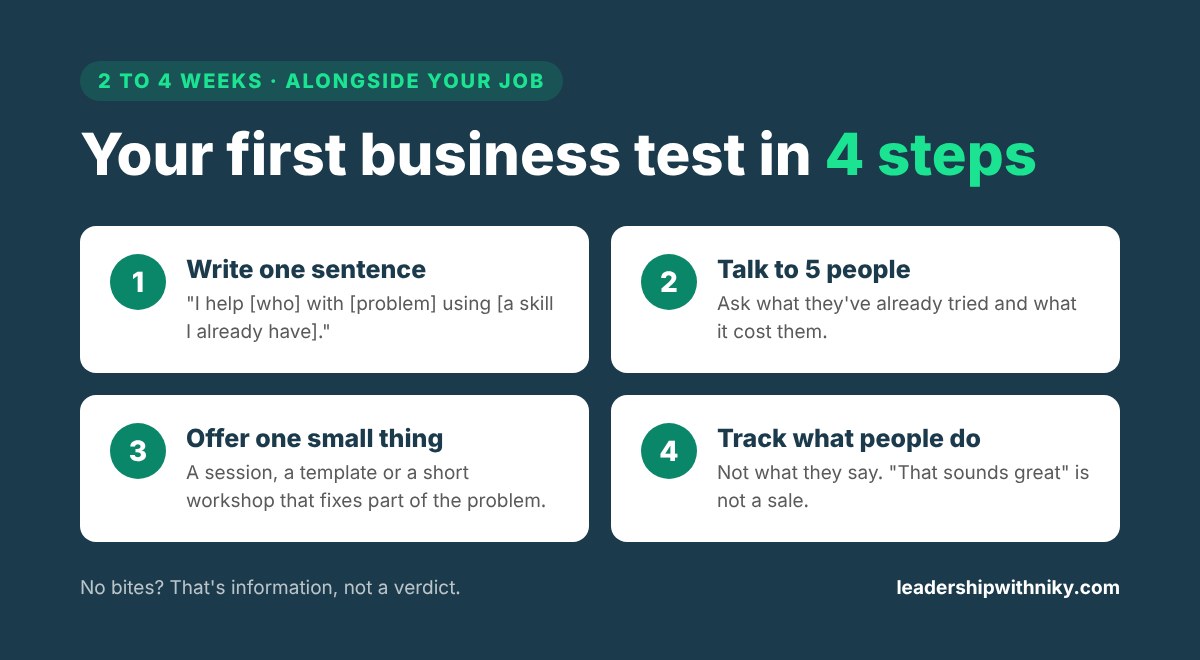
Write one sentence: "I help [who] with [problem] using [skill I already have]."
Talk to 5 people who have that problem. Ask what they've already tried and what it cost them.
Offer one small thing to fix part of the problem, such as a session, a template or a short workshop.
Track what people do, not what they say. A "that sounds great" is not a sale.
If nobody bites, that's not a verdict on you. It's information, and it cost you two weeks instead of two years. That's the logic behind the 30-day experiments I run in public in my free From Job to CEO Skool community.
Quitting first vs building while employed: how do they compare?
For most people with a mortgage and a family, building while employed wins on risk, and quitting first wins only on speed. Here's the honest side-by-side.
Quit first, then build | Build while employed (hybrid) | |
|---|---|---|
Income while testing | Savings only | Salary covers the basics |
Pressure on every decision | High: the business has to pay bills fast | Lower: you can let a test run its course |
Time available | Full days | 5 to 8 focused hours a week |
Business survival | Baseline | 33% lower risk of closing (Raffiee and Feng, 2014) |
Best for | People with a big runway and a proven idea | People still finding out what works |
The trade-off is speed. Building on the side is slower, and slow can feel like failing. It isn't. Slow and still going beats fast and finished.
How do you know if your side business is working?
You know it's working when the numbers move, not when you feel busy. Track a few things weekly so you stop guessing.
At minimum, I'd track:
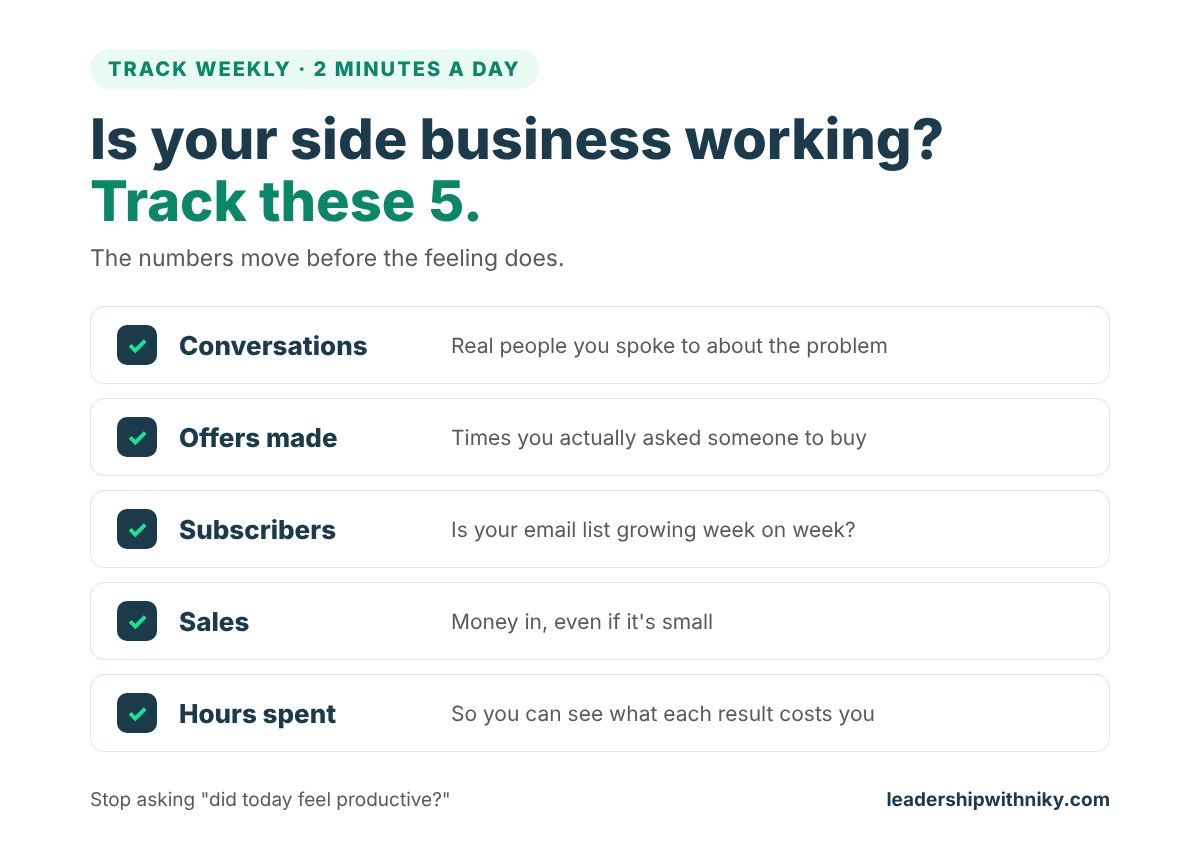
Conversations: how many real people you spoke to about the problem
Offers made: how many times you actually asked someone to buy
Subscribers: whether your email list is growing week on week
Sales: money in, even if it's small
Hours spent: so you can see what each result costs you
I keep mine in the 60-day Google Sheets dashboard I use to track my own business, one row a day, about two minutes of input. The moment I stopped asking "did today feel productive?" and started asking "what did the numbers show?", my decisions got much easier.
When should you quit your job?
Quit when your business has a repeatable way to make sales, not when you feel ready. Ready rarely arrives, and feeling fed up isn't a business plan.
A useful line to draw is a monthly number: what your business would need to bring in, consistently, to cover what your salary pays for, including things that are easy to forget like retirement contributions, insurance and leave. Know that number before you hand in your notice, and if you want help, my From Salary to Sales guide works out your quit number with you.
And here's the part nobody says out loud. You might decide not to quit at all. Some people want a business that sits beside their job for good. The goal isn't a resignation letter. It's having the choice.
FAQs: Starting a Business While Working Full Time
Can I legally start a business while working full time?
Usually yes, but check your employment agreement first. Look for clauses on conflicts of interest, secondary employment and intellectual property. Keep business work on your own devices and your own time, and avoid selling to your employer's clients.
What is a hybrid entrepreneur?
A hybrid entrepreneur is someone who runs a business while keeping a paid job. Research by Raffiee and Feng (2014) found hybrid entrepreneurs who later went full time had a 33% lower risk of their business closing than people who quit to start.
What's the best business to start while working full time?
The best business is usually one built from skills you already use at work, because you understand the problem and can explain it with real examples. Services, templates and small workshops are easier to test in limited hours than products that need manufacturing or stock.
How do I find time to start a business with kids?
Find two or three protected blocks a week, such as after bedtime, a lunch break or an early morning, and guard them like meetings. Prepare the next task the night before so you start immediately instead of spending half the block deciding what to do.
Start with what you already know
You don't need to quit, and you don't need a brand-new idea. You need an idea built from what you already know, a few protected hours a week, and a small test that tells you the truth.
Start there. The rest gets clearer once you have real numbers instead of guesses.
If you're not sure which of your skills could become a business, my free framework walks you through it step by step, with a workbook and a video walkthrough.
👉 Get the free From Job to CEO Framework
What's the one thing you do at work that people keep asking you for help with? Come and tell me in the free From Job to CEO community on Skool. It's where I'm testing all of this in public.
About the author: Niky Egerton has 18 years of leadership experience, a BCom, a Masters of Entrepreneurship and a Prosci Certified Change Practitioner certification. She built BizCalc, a business feasibility model from her Masters research tested with 50 business owners, and is a mum of two building Leadership with Niky alongside her full-time job in New Zealand. She helps employed professionals find the business hiding in their existing skills and test it before betting their income on it. More about Niky's background