
How to Turn Your Skills Into Income From Your Job
Want to turn your skills into income? Start with the work you dismiss as "I just...", find who doesn't have that skill in-house, and test one small offer.
Last updated: 9 October 2026
"Oh, I just love spreadsheets."
I hear some version of that sentence all the time. It usually comes from the person who organises everything, hits every deadline and quietly holds the team together. They say it like it's a quirk, not a skill anyone would pay for.
Here's the short answer. You can turn your skills into income by selling the thing you already do well at work to people who don't have that skill in-house. The skill most worth selling is often the one you've stopped noticing, because it feels too easy to count.
Below is how to spot it, who pays for it, and the first small step to test it, including how I turned nearly 20 years of leadership into a business after getting it wrong first.
Can you really turn your job skills into income?
Yes. Skills you use at work every day are one of the most common foundations for a small business, especially services. You don't need a new passion or a new qualification to start. You need a problem you already know how to solve.
The numbers back this up. Upwork's Freelance Forward 2023 study of 3,000 US working adults found 64 million Americans freelanced that year, and 47% of them sold knowledge services such as marketing, IT and consulting.
Marketing, IT and consulting aren't hobbies. They're skills people usually build at work, which is why this post is about your job skills, not turning your weekend baking into a side hustle. Your job has been training you for years. The question is who else needs what it taught you. If you're still working out whether to keep your job while you build, start with my guide to starting a business while working full time.
Why can't you see your own most valuable skills?
You can't see your most valuable skills because they've become automatic, and automatic feels like "anyone could do that." The biggest mistake I see is going too shallow on what counts as a skill.
When you've done something hundreds of times, you forget what it was like not to know how. So you assume everyone can do it, and you write it off. That's why people list their job title when you ask about their skills, instead of the thing they're quietly brilliant at.
What comes easily feels like "who cares, everyone can do it." But it's often the thing you could teach in your sleep that's a heavy lift for someone else. These are transferable skills, meaning skills that carry over from one role or industry to another, and they're the easiest ones to miss in yourself.
There is always gold in the things that are super easy for you.
What counts as a skill you can sell?
A sellable skill is anything you do reliably that saves someone else time, money or stress, including the systems you run without thinking. It's rarely the job title. It's what's underneath it.
Take the person who says "if I'm not organised, I feel out of control." They almost always have a system behind it they don't realise they're following, like a mental checklist they run every time a new project lands. That checklist is the product. Not everyone can deliver projects on time or organise their brain so it isn't scattered.
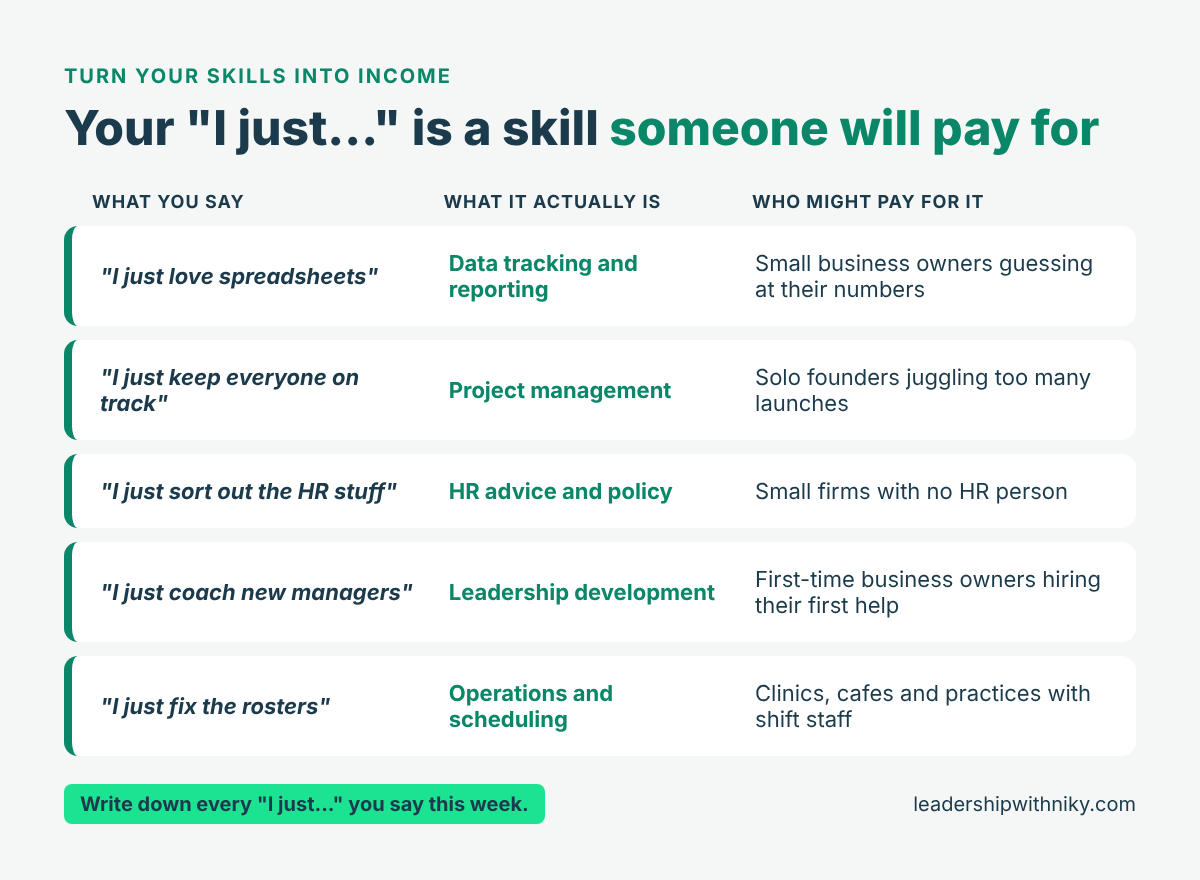
Here's how the "I just..." sentences translate:
What you say | What it actually is | Who might pay for it |
|---|---|---|
"I just love spreadsheets" | Data tracking and reporting | Small business owners guessing at their numbers |
"I just keep everyone on track" | Project management | Solo founders juggling too many launches |
"I just sort out the HR stuff" | HR advice and policy | Small firms with no HR person |
"I just coach new managers" | Leadership development | First-time business owners hiring their first help |
"I just fix the rosters" | Operations and scheduling | Clinics, cafes and practices with shift staff |
Write down every "I just..." you say this week. That's your raw material.
How did I turn 20 years of leadership into a business?
I turned my leadership experience into income only after I stopped selling it to people who already got it for free, and started selling it to people who'd never had it. The first version didn't work.
With nearly 20 years in senior leadership, I couldn't see how that became a business unless I called myself a "leadership consultant," and I didn't like the sound of that. So I made YouTube videos on how to be a good leader, for ages. Almost nobody bought anything, because most people get leadership training free through their employer.
The turning point came from a business coach who asked a better question. What does a solopreneur, someone running a business on their own, need from someone who has spent two decades leading leaders?
The answer was the same things I'd done at work. Leading leaders is mostly about delegation and separating real priorities from busy work. Business owners need exactly the same thing. They just don't have a manager teaching it to them.
What that looked like in practice
Two of my products came straight out of skills I'd been using at work for years. Neither started as a "business idea."
The CEO Dashboard. Instead of paying for a $10,000 mastermind to keep me accountable, I built a Google Sheet to track my own business. I used it for three months, realised other people could use it, and started selling it as the CEO Dashboard I built to track my own business.
The CEO Delegation Kickstart. Years of deciding what to hand to which person on a team became a tool that helps owners decide what to give to automation and what to give to a person. It's the Delegation Kickstart for business owners.
My analytics and data skills, which I'd treated as a side note to "real" leadership, turned out to matter most. So did my Masters of Entrepreneurship, which gave me the testing side.
Who will pay for a skill your employer gets for free?
The people who pay for your skill are the ones who don't have it in-house: smaller businesses, solo owners and teams without a specialist. Your employer has you. Lots of businesses don't have anyone.
A former colleague of mine is the clearest example I know. They started in an admin role supporting an HR consultant, learned on the job, and moved into an HR advisor role. No fancy title, no extra degree, just years of doing the work.
After becoming a parent, they wanted work to fit around life, not life around work. So they started an HR consulting business, giving paid HR advice to other firms as one-off jobs or on a retainer, meaning a set monthly fee for ongoing support. It works really well for them.
Same skill, different buyer. Their old employer had an HR team. The small firms they now work with don't. That gap is the business.
What are the main ways to turn your skills into income?
The four most common ways to sell a skill are a one-off service, a retainer, a digital product and a workshop, and they suit evening hours very differently. If you're still employed, start with whichever you can test fastest.
Model | Example | How fast to test | Fits around a full-time job? |
|---|---|---|---|
One-off service | A single HR policy review | Fast: one client, one job | Yes, if the scope is small |
Retainer | Monthly HR support for a small firm | Slower: needs trust first | Only with clear limits on hours |
Digital product | A template or tracker like the CEO Dashboard | Medium: needs a way to reach buyers | Yes: built once, sold many times |
Workshop or teaching | A 60-minute session on your system | Fast: one date, a few seats | Yes, in an evening or weekend slot |
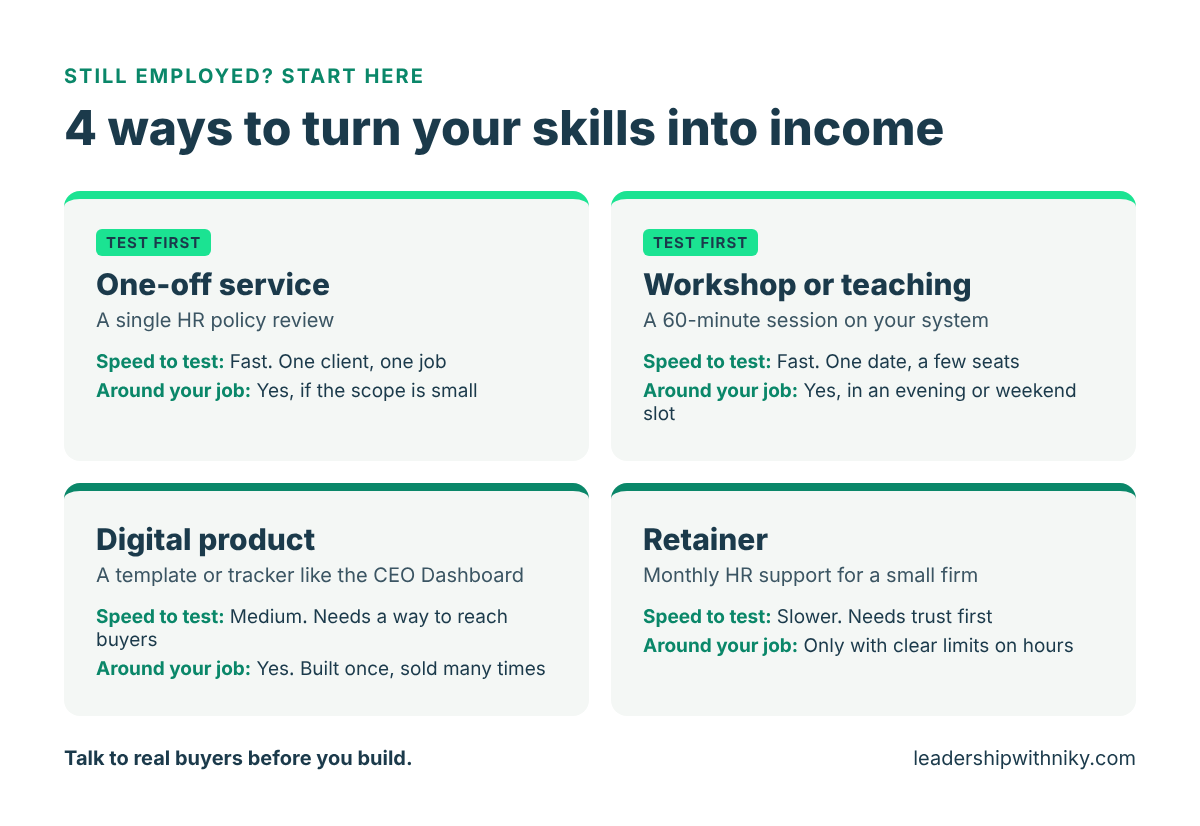
My advice is to start with a small service or a workshop. Talking to real buyers teaches you what they'll pay for faster than building a product nobody has asked for. That's exactly the mistake I made with YouTube.
What's the first step to turning your skills into income?
The first step is a one-week "I just..." audit: write down every task people ask you for help with and every time you play down something you're good at. It costs nothing and takes two minutes a day.
At the end of the week, look for the item that shows up most and that someone outside your workplace would struggle with. Then ask one question about it: who doesn't have this in-house?
That's as far as you need to go this week. The next step is checking whether anyone will actually pay, which I cover in the pillar guide to testing a business idea while you keep your job.
Trust what you know. Then test it.
FAQs: Turning Your Skills Into Income
How do you turn your skills into money?
Start with a skill you already use at work that people ask you for help with. Find who doesn't have that skill in-house, such as small businesses or solo owners, and offer one small paid thing: a one-off service, a short workshop or a template. Then track who actually buys.
How do I turn myself into a business?
You turn yourself into a business by packaging what you know into something specific a buyer can say yes to. A good first sentence is "I help [who] with [problem] using [skill I already have]." In my own business, that meant turning leadership skills into tools like the CEO Dashboard.
Is $5,000 enough to start a business?
For a skills-based business, often yes, and many start with far less, because the main asset is what you already know. A service or workshop needs little more than a way to take payment and talk to buyers. Test whether people will pay before spending much. This is general guidance, not financial advice.
I have skills, but how do I actually earn money from them?
The missing piece is usually the offer, not the skill. Pick one problem your skill solves, one type of person who has that problem, and one small thing they can buy. Then talk to five of those people. If you're still employed, check your employment agreement before you start selling.
Start with what's easy for you
You don't need a brand-new idea to start earning from your skills. You need to take seriously the things you've been brushing off as "I just...", find the people who don't have them, and test one small offer.
The skill that feels too easy to count is usually the one worth testing first.
If you want help working out which of your skills could become a business, my free framework walks you through the Discover stage step by step, with a workbook and a video walkthrough.
👉 Get the free From Job to CEO Framework
What's your "I just..."? Come and share it in the free From Job to CEO community on Skool, and I'll help you work out who might pay for it.