
How I Grew My Email List From 4 to 1,000+ Without Social Media
How to grow an email list without social media: what took my list from 4 to 1,000+ subscribers, why hosting beat contributing, and why quality beats size.
Last updated: 27 October 2026
In October 2025, my email list had 4 people on it. I'm fairly sure I knew all of them.
Before the end of June 2026, it passed 1,000. I didn't post on Instagram to get there, I didn't run a TikTok account, and I did it in the evenings around a full-time job and two kids.
Here's the short answer. You can grow an email list without social media by putting something valuable of yours in front of other people's audiences, through bundles, collaborations and guides, instead of building an audience from scratch one post at a time. The method that worked best for me was hosting my own collaborations, because I chose a topic my ideal subscribers actually cared about.
Below is what "without social media" means for me, what each method brought in, why some of my early subscribers left almost as fast as they joined, and one first step you can take this week.
Can you really grow an email list without social media?
Yes. Plenty of business owners grow their email lists through search, partnerships and other people's audiences instead of daily posting. Social media is one way to find subscribers, not the only one.
Kate Kordsmeier, founder of Success with Soul and the business coach whose program I'm studying, is the example I learn from most. She quit social media in 2021 and has said her business grew 165% afterwards (Kate Kordsmeier on The Amy Porterfield Show).
The numbers on organic social reach are part of why this matters. Socialinsider's 2026 study of brand pages found Instagram reach fell 14% year on year, and even small accounts with 1,000 to 5,000 followers reached only about 6.65% of their followers per post (Socialinsider's 2026 social media reach study).
That's roughly 1 in 15 of the people who already chose to follow you. When you're building in the evenings, that's a lot of posting for a small slice of attention.
What does "without social media" actually mean for me?
For me, it means no regular posting on Instagram, Facebook or TikTok to bring in subscribers. I want to be precise about this, because "without social media" can sound like a bigger claim than it is.
I did post on Facebook for a while, but only because some bundles I joined required contributors to promote them there. I wasn't using it to grow, and I've stopped. I recently turned my Instagram into a static nine-post grid using Kate's Beyond the Scroll (affiliate link, so I may earn a commission if you buy through it). Now my profile explains what I do without me needing to show up there at all.
I do post the odd YouTube video, though hardly ever. Some people would count YouTube as social media, so take that as my full disclosure. None of my list growth came from it.
These days I'm testing a blog instead, which is the experiment you're reading. The rule I follow is simple: my time goes into things that put me in front of the right people more than once.
How did I grow from 4 to 1,000+ subscribers?
I grew my list by joining other people's collaborations first, then hosting my own, and hosting is what made the biggest difference. It took about nine months, from October 2025 to just before the end of June 2026.
Phase 1: contributing to bundles
I started by contributing to bundles. In a bundle, several business owners each give away one of their paid products for a limited time, and everyone promotes the whole collection to their audiences. In return, every contributor gets seen by people they'd never reach alone.
It worked, slowly. By February 2026 I had 283 subscribers. But some bundles brought in a lot of people who then unsubscribed almost straight away. Some of the topics were close to my audience, but not close enough, and some people were there for the paid products, not for me.
Phase 2: hosting my own
In April 2026, I hosted my first bundle, the From Job to CEO Bundle. Close to 500 people signed up, though some were already on my list. My second hosted bundle brought in a similar number, and later my collaborative guide, Before It Clicked, brought in slightly fewer but still a similar amount.
Hosting brought in more people in one go than months of contributing had.
What's the difference between contributing to a bundle and hosting one?
When you contribute, the host chooses the topic and the audience. When you host, you choose both, and that decides who lands on your list. That one difference explains most of my results.
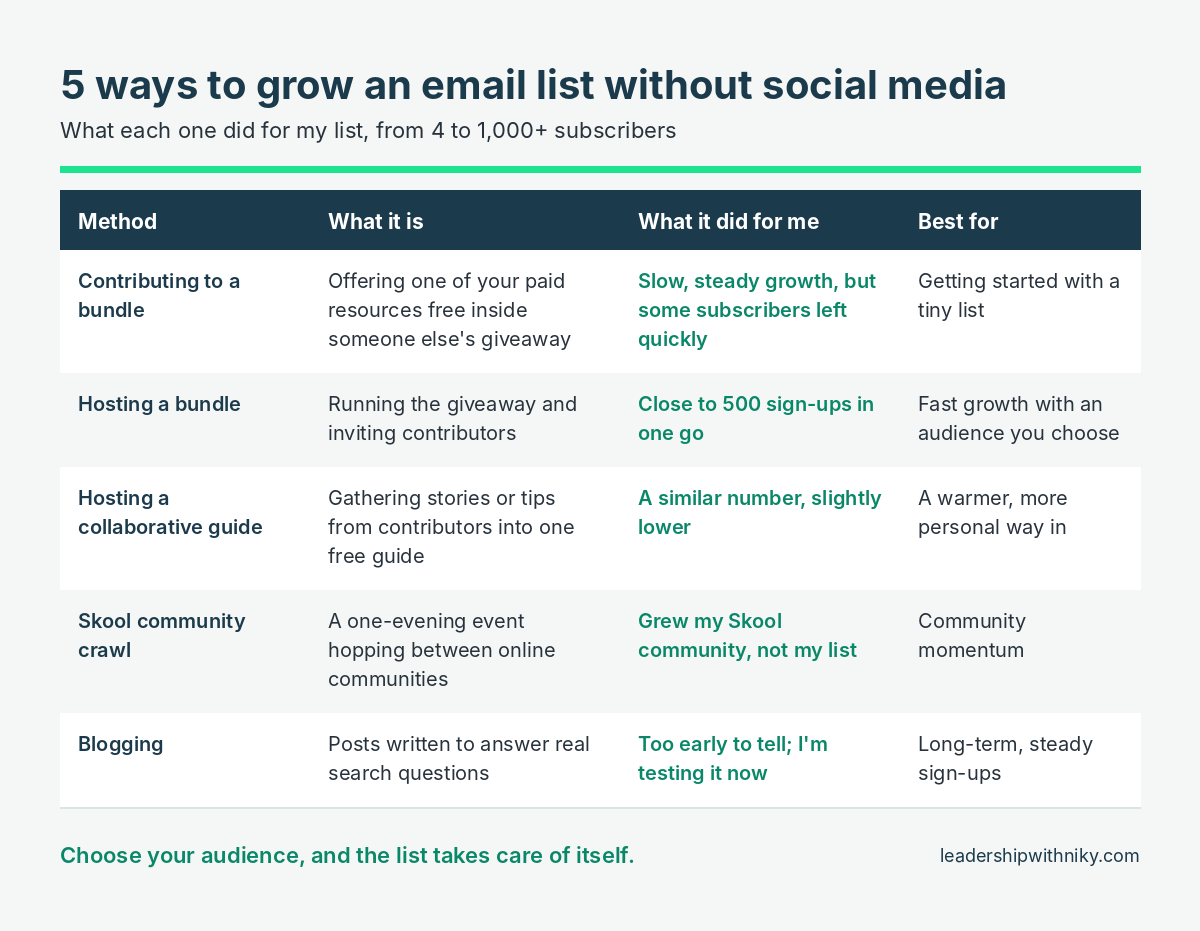
Method | What it is | What it did for me | Best for |
|---|---|---|---|
Contributing to a bundle | Offering one of your paid resources free inside someone else's giveaway | Slow, steady growth, but some subscribers left quickly | Getting started with a tiny list |
Hosting a bundle | Running the giveaway and inviting contributors | Close to 500 sign-ups in one go | Fast growth with an audience you choose |
Hosting a collaborative guide | Gathering stories or tips from contributors into one free guide | A similar number, slightly lower | A warmer, more personal way in |
Skool community crawl | A one-evening event hopping between online communities | Grew my Skool community, not my list | Community momentum |
Blogging | Posts written to answer real search questions | Too early to tell; I'm testing it now | Long-term, steady sign-ups |
Hosting is a lot more work. You're recruiting contributors, building the opt-in page, writing the emails and keeping everyone promoting. But every person who signs up came for a topic you picked, which is exactly why they stay.
Why is list quality worth more than list size?
List quality matters more than size because subscribers who don't want what you offer won't open, won't buy and often won't stay. A big number that doesn't care about your work is just a big number.
I saw this early. Some of the bundles I contributed to sent me a wave of new subscribers, and a lot of them unsubscribed within days. They'd signed up for a pile of free stuff, not for me. That's not a criticism of them or the hosts. The topic simply wasn't aligned enough with what I help people do.
There's a tension built into bundles, too. Contributors usually give away something they normally charge for, so a bundle attracts people who love getting paid things for free alongside the people who'll stay. I find that balance hard. It's also why I have a clear line on what will never go in a bundle, because I don't want my whole shop to be free somewhere.
Hosting helped with the quality problem, because I chose the topic. The people who joined were already interested in leaving a job to build a business, which is the whole point of my work.
If I had to choose between 1,000 aligned subscribers and 5,000 people who signed up for freebies, I'd take the 1,000 every time. You can't sell to people who were never looking for what you do.
Do you have to post on social media consistently to grow?
No. Posting consistently on social media is one way to grow, but it's not a requirement, and it's not the only path that works. I've listened to plenty of experts say you have to show up every day, and I believed it for a while.
What I've found is that consistency matters, but it doesn't have to be consistency on social media. It can be consistently joining aligned collaborations, consistently emailing your list, or consistently publishing answers to the questions your audience is searching for.
If you enjoy social media and it brings you the right people, keep going. This isn't an argument against it. It's permission to stop if it's draining your limited evenings and not filling your list.
For employed founders, the trade-off is real. A collaboration is a burst of focused work for a few weeks. Social media is a daily habit that never really ends. I know which one fits around school pickups and a full-time role.
How do you grow an email list while working full time?
Choose methods that work in bursts and keep working when you're not there, rather than ones that need you every day. Your evenings are limited, so each hour should bring people onto your list more than once.
That's why collaborations suited me. I could put in a heavy few weeks to host a bundle, then step back while the emails I'd scheduled did their job. A blog post works the same way: write it once, and it can keep answering a search for months. I'm testing that now, and I'm sharing the numbers in my From Job to CEO Skool community as I go.
I also treated list growth as a series of experiments, not a vague goal. In my first 30-day experiment, bundles brought in the warmest people by far, which I wrote about in how to test a business idea in 30 days without quitting.
Track where each subscriber came from. The source tells you what to do more of.
What's the first step to growing your email list without social media?
This week, look at where your current subscribers came from, and roughly how many from each source are still on your list. If you're starting from zero, find one collaboration whose audience is the people you want to help.
Most email platforms let you tag or filter subscribers by the form they signed up through. Two columns are enough: source, and how many stayed. You'll probably spot a pattern within 20 minutes.
If you have no list yet, don't wait until you're "ready" to host. Join one bundle or guide where you can say, hand on heart, that the host's audience is your audience. Ask the host who usually signs up before you commit, and decide in advance which of your products will never be given away.
An exciting invite email makes it hard to judge a collaboration clearly. I built the Collaboration Filter after saying yes to bundles that weren't aligned enough. It scores a bundle, email swap or summit out of 10 and gives you a clear yes or no before you commit your evenings to it.
And if you're not sure yet who your list is for, start there. How to turn the skills from your job into income helps you find the people your skills serve. For the bigger picture of building around a job, read my guide to starting a business while working full time.
Trust what you know about your audience. Then test it.
FAQs: Growing an Email List Without Social Media
How do I grow an email list?
Offer a free resource that solves one specific problem, then put it in front of people who already have that problem. Without social media, that usually means collaborations like bundles and guides, search traffic from a blog, and partnerships with other business owners. Track where each subscriber comes from so you know what to repeat.
What's the easiest way to build an email list if I don't have a website?
Most email platforms give you a free sign-up page, so you don't need a full website. Create a simple sign-up page, then join a bundle or collaborative guide. Bundles usually ask for a product you'd normally sell, so choose one you're happy to give away. The host promotes the whole collection, so people find you without a site or audience.
How do you build an email list from scratch with zero social media following?
Borrow attention from people who already have an audience. Contribute a resource to bundles and guides that match your ideal subscriber, and say yes to email swaps with business owners who serve the same people. Once you've learned what works, hosting your own collaboration usually brings in more people at once.
What is a good replacement for social media for a business?
For most small business owners, the best replacements are an email list, search through a blog or Pinterest, and collaborations with other business owners. These keep working when you're not posting. The right mix depends on how much time you have, and whether you'd rather write, partner or teach.
Grow the list that wants what you do
You don't need to post every day to build an email list. You need a free resource people actually want, a way to put it in front of the right audience, and the honesty to care more about who joins than how many.
I started with 4 subscribers. The thing that moved me past 1,000 wasn't more effort. It was choosing who I was talking to.
If you're still working out who your business is for and what you'd offer them, my free framework walks you through finding the business in the skills you already have, step by step, with a workbook and a video walkthrough.
👉 Get the free From Job to CEO Framework
Where have your best subscribers come from so far? Come and tell me in the free From Job to CEO community on Skool.