
How to Test a Business Idea in 30 Days without Quitting
Want to test a business idea without quitting your job? Pick one small piece, set your number first, run it for 30 days and track what people actually do.
Last updated: 16 October 2026
In my first 30-day experiment, one of my Meta ads sent 1,634 people to my free community in a week. One of them joined.
That number stung. It also taught me more than any business book had: attention isn't a yes. Lots of people looking at something is not the same as people choosing it.
Here's the short answer if you're reading this with limited time. To test a business idea without quitting your job, pick one small piece of it, decide before you start what number counts as a yes, run it for 30 days in protected hours, and track what people do, not what they say.
Below is why testing beats building first, the small tests that fit around a full-time job, what my own experiments showed (including the one where I missed my target), and one step you can take this week.
Why should you test a business idea before you quit your job?
Test first, because many new businesses close early, and a common root cause is building something not enough people want. A 30-day test costs you a few evenings. Finding out the hard way can cost your savings.
The US Bureau of Labor Statistics (BLS), the government agency that tracks how long businesses survive, shows about 22% of private businesses that opened in the year to March 2024 had closed a year later. Of those that opened in the year to March 2020, only about half were still open five years on (BLS survival data for new businesses).
Even well-funded startups hit the same wall. CB Insights' 2026 analysis of 385 venture-backed companies that shut down since 2023 found 43% cited poor product-market fit, meaning they never found enough people who wanted what they built (CB Insights' 2026 report on why startups fail).
Your job gives you something those founders didn't have: time to find out cheaply. I covered why keeping it is often the smarter move in my guide to starting a business while working full time.
What does it actually mean to test a business idea?
Testing a business idea means running a small, real-world action and measuring whether real people respond, before you put serious time or money in. Validating a business idea is the result: evidence that people want it enough to act.
Many startup guides draw on Testing Business Ideas by David J. Bland and Alex Osterwalder of Strategyzer. It splits an idea into three questions: do people want it (desirability), can you deliver it (feasibility), and will it make money (viability).
Whether it will make money is the next question, and it's the one I spent my Masters of Entrepreneurship on, building a feasibility model I tested with 50 business owners. But profit doesn't matter until someone wants the thing, so start with that.
Here's what doesn't count as a test:
Asking friends and family what they think
Getting a score from an AI validator tool
Likes, views or "this sounds great!" comments
A real test asks for an action that costs the other person something: their email address, their time on a call, or their money.
Why test a business idea for 30 days?
Thirty days is long enough to see a pattern and short enough to stay committed while you hold down a job. A one-week test mostly measures luck. A six-month test is easy to abandon halfway.
I've run a 30-day experiment every month since April in my free Skool community, From Job to CEO: The Experiment. Each one tests one thing, against one number, reported in public, including the bits that make me look less than polished. Seven experiments in, the 30-day length has held up every time.
It also fits real life. A 30-day test needs a few protected blocks a week, not every evening. If your energy after work is the real problem, start with how to work on your business when you're tired after work.
The time limit does a second job too: it forces a decision. At day 30 you keep it, change it or stop it, instead of "seeing how it goes" for another six months.
What happened when I ran my first 30-day experiment?
My first 30-day experiment missed its target, and it was still one of the most useful things I've done in my business. The goal was 100 members in my new Skool community in 30 days. I finished on 76.
But the daily numbers told me exactly where to put my limited hours next:
What worked: a bundle, a collaborative giveaway where several business owners share free resources with a combined audience, brought the warmest visitors and the best conversion by a mile. A community crawl, a one-evening event hopping between Skool groups, brought in 11 members in one night.
What didn't: two small Meta ads. The second sent 1,634 visitors to my page in a week and brought in 1 member.
The slightly annoying one: every time life took over and I stopped showing up, growth slowed straight away.
Without the numbers, I'd probably have kept running ads because the visitor count looked exciting. Missing 100 didn't make the test a failure. It made the next decision obvious.
The year I didn't test
The contrast with my old leadership YouTube channel still makes me wince. I made two videos a week for nearly a year before checking whether anyone would buy, and almost nobody did.
When I tested YouTube again as a 30-day experiment, I had my answer in about a month: 5 videos, 22 new subscribers and no new community members coming straight from YouTube. So I kept it, at two videos a month, instead of either dropping it or burning out on it.
A year of guessing, versus 30 days to a decision. I know which one I'd rather repeat.
What small tests can you run on a business idea while working full time?
The best tests for employed founders are small, cheap and repeatable inside a few hours a week. You don't test your whole business at once. You test one piece of it.
These are tests I've run in my own business or seen other business owners run in the communities I'm part of:
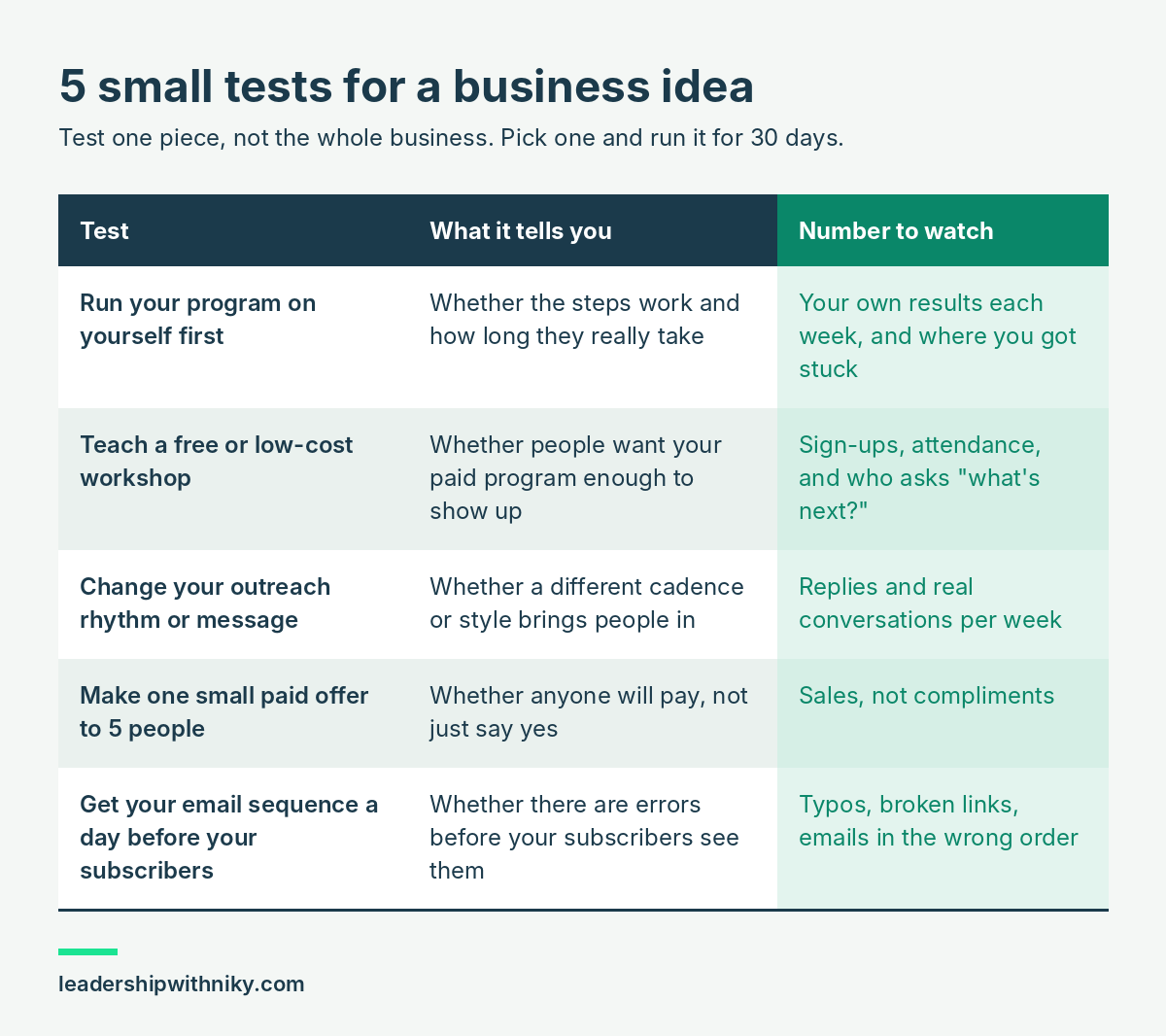
Test | What it tells you | Number to watch |
|---|---|---|
Run your program on yourself first | Whether the steps work and how long they really take | Your own results each week, and where you got stuck |
Teach a free or low-cost workshop | Whether people want your paid program enough to show up | Sign-ups, attendance, and who asks "what's next?" |
Change your outreach rhythm or message | Whether a different cadence or style brings people in | Replies and real conversations per week |
Make one small paid offer to 5 people | Whether anyone will pay, not just say yes | Sales, not compliments |
Subscribe yourself so you get your email sequence a day early | Whether there are errors before your subscribers see them | Typos, broken links, emails in the wrong order |
The last one sounds tiny. It isn't. A broken link in a welcome email can quietly wreck a test you thought was about your offer.
How do you know if your business idea test worked?
You know a test worked when it hits a number you chose before you started, not when it feels promising. Decide your yes in advance, or you'll move the goalposts once the results come in.
Change one thing at a time, too. In my welcome email experiment, one email pitching my Starter Kit got no clicks. Two emails later, the same offer was my best performer. The offer wasn't the problem. The email was, and I could only see that because I hadn't changed everything at once.
At day 30, make one of three calls:
Keep it: it hit your number, so do more of it
Change it: something moved but not enough, so adjust one thing and run it again
Stop it: nothing moved, so stop and test something else
I log mine in the CEO Dashboard I use to track my own business, about two minutes a day. A stopped test isn't a failure. It's the cheapest lesson you'll get all year.
What do people get wrong when they test a business idea?
The most common mistake is testing several things at once, so you can't tell what made the difference. I've done it. At one point I had 17 sales funnels, the automated paths that move someone from a free resource to a purchase, and I couldn't tell which ones were doing anything.
The other mistakes I see most often:
Counting compliments as demand. "I'd definitely buy that" is not a sale.
Calling it in week 1. Early results often look flat, especially when you're testing something new on yourself or a small list.
Planning instead of launching. Planning a test feels like progress. It isn't progress until something is live and people can respond.
Taking a no personally. A no is information about the offer, not a verdict on you.
Trust what you know. Then test it, one thing at a time.
What's the first step to testing your business idea this month?
Write one sentence before you do anything else: "For the next 30 days, I'll test [one thing], and I'll count it as a yes if [number]." Then put Day 1 in your calendar.
Keep the first test small enough to start next week with the hours you actually have. A workshop for 5 people beats a course for 500 that you'll finish in a year. You can make it bigger once you have real numbers.
If you're not sure what the one thing is yet, start with the idea itself. how to turn the skills from your job into income walks through finding it in work you already do every day.
FAQs: Testing a Business Idea
Q: How do you test if a business idea will work? A: Pick one small piece of the idea, such as a workshop, a single service or a template, and offer it to real people who have the problem. Decide in advance what result counts as a yes, run it for about 30 days, and judge it on actions like sign-ups and sales rather than opinions.
Q: What is an easy way to validate your business idea? A: Make one small offer to five people who have the problem you solve, and ask them to act: book a call, join a waitlist or pay. If nobody acts, that's useful evidence and it cost you very little. If several people do, you have a real reason to build more.
Q: Can I test a business idea while working full time? A: Yes, and a job can make testing easier, because your salary covers the bills while you find out what works. Use two or three protected blocks a week and keep each test small. Check your employment agreement for conflict-of-interest or secondary employment clauses first. This is general guidance, not legal advice.
Q: How do you use AI to validate a business idea? A: AI is useful for planning a test: listing your assumptions, drafting questions for customer conversations or estimating costs. It can't tell you whether real people will pay, because it isn't the one reaching for a credit card. Use AI to sharpen the test, then run the test with real people.
Start small and let the numbers decide
You don't need a perfect idea or a year of building to find out if something works. You need one small test, one number decided in advance, and 30 days of protected hours.
Missing your target is fine. Not knowing why is the expensive part.
If you're still working out which idea to test, my free framework walks you through finding the business in your existing skills, step by step, with a workbook and a video walkthrough.
👉 Get the free From Job to CEO Framework
What's one thing you could test in the next 30 days? Come and tell me in the free From Job to CEO community on Skool. I'm reporting my own blogging experiment numbers there as I go.