
How to Stop Your Job Draining Your Energy (Without Quitting)
Is your job draining your energy? You don't have to quit or just recover better at night. Here's how I protect my energy during the work day instead.
Last updated: 30 October 2026
It's Tuesday, 5:30pm. I've had back-to-back meetings since nine, most of them face to face, because that's how I've planned my office days.
By the time I get to the car, I'm flat. And I still have dinner, homework and an evening of business work ahead of me.
Here's the short answer. If your job is draining your energy, you don't have to choose between quitting and simply recovering harder at night. You can protect your energy during the work day itself: plan your hardest days on purpose, book small breaks nobody can take, keep to your hours, and give your head a clear end to the day.
Below is why work drains you, what I've changed on my own office days, what I notice from the leadership side, and one step you can take this week.
Why is my job draining my energy?
Your job drains your energy when its daily demands outrun the recovery you get during and after the day. Meetings, people, decisions and constant interruptions all draw from the same tank, and most jobs never schedule time to refill it.
You're far from alone. Gallup's State of the Global Workplace 2026 report, based on 2025 data from more than 141,000 employed people, found 40% of employees worldwide felt a lot of stress the previous day. In the United States and Canada it was 50%, and in Australia and New Zealand 49%. Managers reported more daily stress than the people they lead, 45% against 39% (Gallup's State of the Global Workplace data).
For me, the drain isn't spread evenly across the week. It's my office days. Knowing which days drain you most is the first step to doing something about it.
Is it normal to feel completely drained after work?
Yes, feeling drained after a demanding day is common, and it doesn't mean you're weak or in the wrong career. It usually means the day took more than it gave back.
What matters is whether it lifts. If a good night's sleep or a quiet weekend brings you back, you're dealing with a tiring job, and the changes in this post can help. If it never lifts, or you're dreading every day, that's more than tiredness. Talk to your doctor or your workplace Employee Assistance Programme (EAP), a free, confidential counselling service many employers offer. This post is general information, not medical advice.
If your evenings are where the drain shows up most, I've written separately about how to work on your business when you're tired after work. This post is about the other end: keeping more of your energy during the day so there's something left to take home.
Why don't "just quit" or "more self-care" fix a draining job?
"Just quit" ignores that your job may be funding your business, and "more self-care" only treats the drain after it's happened. Most of the advice online falls into one of those two camps.
Look at what ranks for this question: walk after work, drink more water, sleep earlier, or "it's a signal, find a role that fuels you." None of it is wrong. But if you're building a business while employed, you're not quitting next week, and a bath at 9pm doesn't give you back the energy you spent at 2pm.
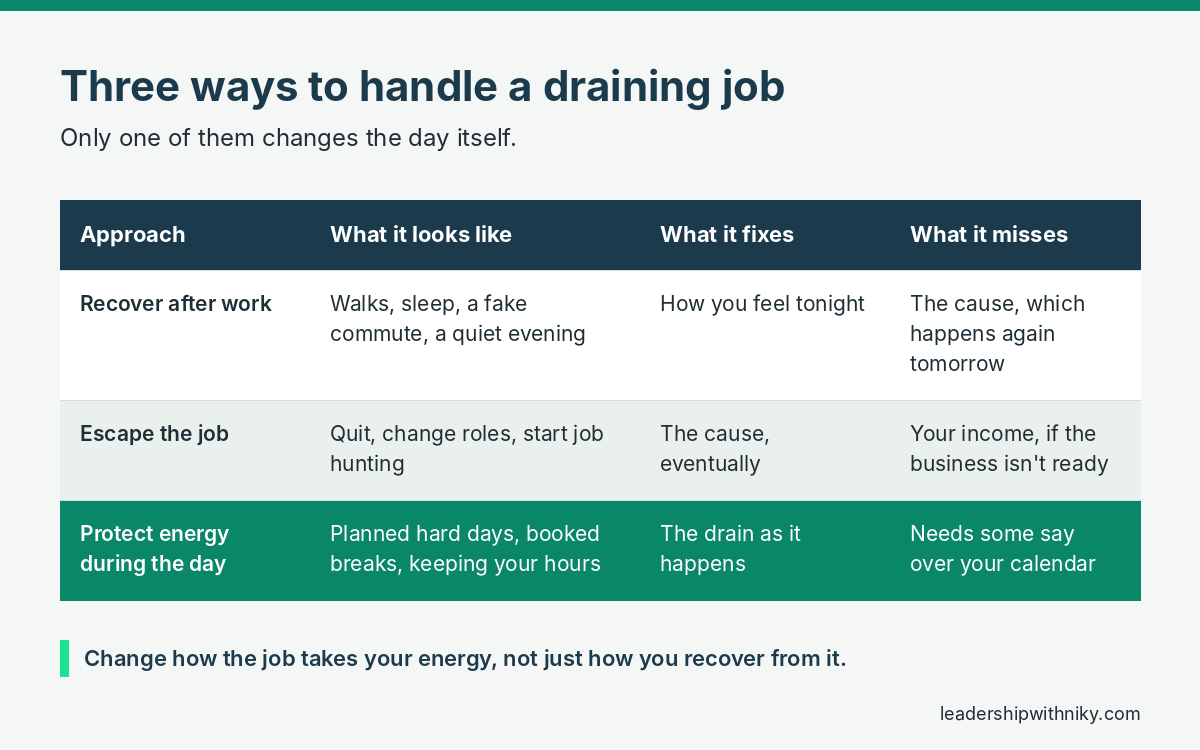
Approach | What it looks like | What it fixes | What it misses |
|---|---|---|---|
Recover after work | Walks, sleep, a fake commute, a quiet evening | How you feel tonight | The cause, which happens again tomorrow |
Escape the job | Quit, change roles, start job hunting | The cause, eventually | Your income, if the business isn't ready |
Protect energy during the day | Planned hard days, booked breaks, keeping your hours | The drain as it happens | Needs some say over your calendar |
There's a middle option: change how the job takes your energy, not just how you recover from it.
How do you protect your energy during the work day?
Plan your hardest work on purpose, so the draining days are the ones you chose, not the ones that happened to you. I'm in the office on Mondays and Tuesdays, and I deliberately stack most of my meetings onto those days.
Part of that is about my team. I want my face-to-face time with my people to happen when I'm actually in the room with them, because that's where the real connection comes from.
The other part is about my business. On my work-from-home days, I will use the small gap of a lunch break to update something on my blog or answer a business email. In the office, that doesn't happen. So if I can get a work meeting or task done on an office day that would otherwise eat into a home day, I'll do it there.
The trade-off is that my office days absolutely zap me. I've accepted that two days a week will be hard, so the other three can be lighter.
Do short breaks actually give you energy back?
Yes. Breaks of 10 minutes or less are linked to more energy and less fatigue, and they're the easiest boundary to set. The trick is protecting them before the day fills up.
A 2022 meta-analysis in PLOS ONE, led by Patricia Albulescu, combined 22 studies and found these "micro-breaks" were generally associated with higher vigor and lower fatigue (the 2022 micro-breaks study).
My version is a morning coffee. On office days I walk around the corner and get one, and I block that 15-minute slot in my diary. It's there so nobody can book a meeting over the top of the one moment I get fresh air.
It sounds tiny. But on a day with no other gaps, a booked break is the difference between running on empty by lunch and getting to the afternoon in one piece.
How do you stop work following you home?
Give yourself a clear switch-off point on the way home, so the work day ends before you walk in the door. If you don't, you carry the day's meetings into dinner and into your business time.
For me, it's the drive. I listen to a podcast on the way home, and it completely takes my head away from whatever happened at work that day. If I'm not in the mood for talking, it's music instead.
By the time I pull into the driveway, I'm good. I'm ready to be a mum, and later, ready to open the laptop for my business.
You don't need a commute to do this. Search results are full of the "fake commute", a short walk after you log off. The idea is the same. The work day needs an ending your brain can recognise.
Should you stop working extra hours when you're building a business?
If you're building a business, unpaid extra hours at your job are energy you could be spending on something that's yours. I learned this the slow way.
I used to work all hours. I was reliable, always available, always the one who'd stay late to finish something. And I found it gave me no real advantage. Nobody noticed the extra evenings, and they certainly didn't change my pay.
Now I work hard to work only my hours. Not less than my job needs, just not the extra. The hours I used to give away for nothing now go into my own business instead.
This isn't about doing your job badly. It's about deciding where your best energy goes, rather than letting your job take it by default.
What does a draining job look like from the leader's side?
From the leadership side, a drained person usually shows it before they say it: their energy is off and they stop connecting. In my people leadership role, I notice it often.
One sign I watch for is cameras. In our online meetings, the expectation is that cameras are on. If someone turns up with theirs off, I'll usually send a quick chat: "Hey, would love to see you, feel free to turn your camera on." If it's one of my direct reports and I get nothing back, I'll call them later to check everything's okay.
Sometimes it's nothing. Sometimes the camera's off so they can answer emails while the meeting runs. Either way, it's a sign their energy is somewhere else.
If you're the drained one, someone has probably noticed. Telling your manager what's draining you is often easier than they expect, and it gives them a chance to help.
What's the biggest mistake people make when their job drains them?
The biggest mistake is trying to do everything at once, at work and in the business, then beating yourself up when it doesn't all get done. That's how a tiring job turns into burnout.
Work travel, work dinners and the odd brutal week will wipe out some of your business evenings. You have no control over that. So plan around the hours you actually have, set goals that fit them, and go easy on yourself when life gets in the way.
Building an online business is usually a long game. Very few people grow one fast. It builds momentum over time, which is exactly why I run my business in small 30-day experiments instead of big all-at-once plans.
Go at a pace you can actually keep. A business you burn out building isn't the freedom you were after.
What's the first step if your job is draining your energy?
This week, find your most draining work day and book one 15-minute break into it, in your calendar, like a meeting. That's the whole step.
Pick the day you know leaves you flattest. Look for a slot before it fills, mid-morning works well, and book it as busy. Then use it for something that isn't work: a walk, a coffee, fresh air.
At the end of the week, notice how that day felt compared with the last one. If it helped, you've proven to yourself that small boundaries work, and you can add the next one.
If you're still deciding whether building a business around your job is right for you at all, start with my guide to starting a business while working full time.
Trust what you know about your own energy. Then test it.
FAQs: When Your Job Is Draining Your Energy
Q: Why do I lose energy at work?
A: You lose energy at work when demands like meetings, people, decisions and interruptions outrun your chances to recover. Back-to-back days with no breaks drain you fastest. Spreading your hardest work across planned days, and booking short breaks before your calendar fills, gives your energy a chance to come back during the day.
Q: What do you do when a job is draining your soul?
A: Start by working out which parts drain you most, then change what you can: book breaks, keep to your hours and end the day clearly. If you also want to leave eventually, build an exit plan rather than quitting on a bad day. A business tested on the side gives you a real option.
Q: Is it normal to feel completely drained after work?
A: Yes, it's common after a demanding day. Gallup found 40% of employees worldwide felt a lot of stress the day before they were surveyed. If rest and weekends bring you back, it's a tiring job. If the drain never lifts, talk to your doctor or your workplace EAP.
Q: How do I get my energy back?
A: Protect it during the day as well as after. Short breaks of 10 minutes or less are linked to more energy and less fatigue, so book one into your hardest day. Then give yourself a clear end to the work day, like a podcast on the drive home, and protect your sleep.
Your job doesn't get all of you
You don't have to quit to stop your job draining your energy, and you don't have to wait until evening to start fixing it. Plan your hard days, book your breaks, keep to your hours and end the day on purpose.
Your job can have a fair share of your energy. It doesn't have to have the best of it.
If you want help setting those boundaries, my free Boundary Rescue Pack helps you protect your energy all day, not just after work, so there's something left for your business and your family.
👉 Get the free Boundary Rescue Pack
Which day of your work week drains you the most? Come and tell me in the free From Job to CEO community on Skool.