
Are Bundles Worth It? How to Choose Which Bundles to Join (While Working Full Time)
Are bundles worth it? Yes, when the audience fits, your product leads to what you sell, and you trust the host. What I learned as a bundle contributor and host.
Last updated: 27 November 2026
In late 2025, I had 4 email subscribers and a business coach telling me bundles were one of the fastest ways to grow a list. So I did what I always do when I decide something. I went all in.
I joined bundle after bundle as a contributor. Each one needed a product I'd normally sell, so I kept making new ones to give away. My list grew quickly. It also left me with too many products, an audience that wasn't sure what I did, and a lot of people who grabbed one thing and left.
Here's the short answer. Bundles are worth it when three things line up: the bundle's audience is the people you want on your list, the product you contribute leads to what you actually sell, and the host is someone you've checked and trust. If you're building around a job, your evenings and your email list are the real price, so be picky.
Below is what I learned contributing, why hosting changed everything, how to check a host, and one step to take before your next yes.
What is a bundle, and what does it cost a contributor?
A bundle is a collection of products from many business owners, given away free or sold cheaply for a short time. Each contributor promotes it, and everyone who claims a product joins that contributor's email list.
The catch is what you put in. A freebie usually means a lead magnet, something that's always free on your website. A bundle is different. Most hosts ask for a product you'd normally sell, offered free for the bundle period.
So contributing costs you more than it looks. You give away a paid product, you send a set number of promo emails to your list, and you spend evenings on setup and graphics. When your business time is mostly after the kids are in bed, every bundle has to earn its place.
The biggest mistake I see, and the one I made, is saying yes without checking how well the bundle's audience and the host's business line up with yours.
Are bundles worth it for small businesses?
Bundles are worth it for small businesses that need list growth and connections, but they're slow for sales. That matches my experience, and it matches what other contributors report.
Copywriter Laura Kendrick of Cheeky Copy describes bundles as strong for volume and relationships but a poor fit if you need sales within about a month (Cheeky Copy's breakdown of what bundle subscribers do next). She also notes a wave of unsubscribes usually follows in the first week or two.
I saw exactly that. Lots of people signed up, got what they came for, and unsubscribed. For context, Mailchimp's benchmark data across all its users puts the average unsubscribe rate at 0.22% per email (Mailchimp's email marketing benchmarks). A post-bundle wave is far bigger than that, so expect it before it stings.
Contributing did grow my list. It just didn't give me the impact I was hoping for. I made some sales from tripwires (a low-priced offer shown straight after someone signs up), but nothing like what came next.
Why does the bundle's audience matter more than its size?
The audience matters more because people who didn't come for what you do won't stay for it. A big list of the wrong people costs you time and gives very little back.
When I was contributing, there were plenty of bundles to choose from. None were specific enough. Most were broadly about "growing an online business", so I ended up with a mix of people who weren't really my audience.
Then I hosted my first bundle in April 2026. Hosting meant I chose the theme, so I could be narrow: only contributors offering tools and resources for people growing an online business, aimed at the people I serve. The right people joined my list, and I made sales from it. It was far faster and far more effective than contributing.
Hosting took me from 4 subscribers to more than 1,000 by mid-2026. I've shared the side-by-side numbers in how I grew my email list without social media.
Honestly, I'm on the fence about hosting again. It's a huge amount of work alongside a full-time job, and bundles have taken off so much that the space feels a bit saturated.
Why should your bundle product match what you actually sell?
The product you contribute should be the first step towards your other offers, or new subscribers will leave as soon as your emails change topic. A random product attracts people for that one thing, then loses them.
This is where I started backwards. I was so focused on having something new for each bundle that I wasn't asking the real question: which people do I need on my list, because of what I'm selling?
So I made product after product. The result was an offer list so wide that it confused people about who it was for. Eventually I had to cut it right back to one clear pathway.
Think about it from the subscriber's side. They claim your product, look at what else you sell, and realise it was made for that bundle and has nothing to do with the rest. Then your emails arrive about something they never wanted, so they unsubscribe. A product that matches your pathway brings in people who might buy the next step.
If you're still working out what your business is actually for, how to choose the right business idea to test first is a good place to start.
How do you tell a good bundle host from a bad one?
A good bundle host is picky about who joins and strict about promotion. Both habits protect every contributor's time, including yours.
I got far better results as a contributor once I got picky about hosts. The good ones had clear criteria for who could contribute, and they expected everyone to promote.
I learned why from the other side. When I hosted, several contributors didn't promote at all. Life happens, and some people are decent enough to let you know. Others just go quiet, and still get new subscribers from everyone else's effort.
I also see the same names in nearly every bundle, often with the same product each time. I don't know how that goes for them. I suspect they keep reaching the same overlapping people, who stop signing up.
Before you say yes, do a little research on the host. Read the contributor details for who the bundle is for, then look at the host's website, emails and past bundles, and how they treat their customers. If you'd be uncomfortable with their name next to yours, that's your answer.
Can you actually send the promo emails the bundle asks for?
Only say yes if you can send the required promo emails without hurting your own list or your own plans. Most bundles ask contributors to send a specific number of emails, and that number adds up fast.
Check the dates against your own calendar before you apply. If you're launching something that week, you could end up sending two bundle promo emails on top of your launch emails. That's a lot of emails in one week, and you could lose subscribers right when the launch is the thing that matters.
Then check your own capacity. Writing, scheduling and tracking promo emails takes evenings, and those evenings are already shared with your job and your family. I wrote about protecting that time in how to start a business without burning out.
A bundle is only worth it if it fits around your plans, not on top of them.
Why does the host matter as much as the audience?
The host matters because their reputation becomes part of yours. If they cut corners with their customers, people will assume you do too.
Alignment usually decides whether a bundle works. Outside bundles, though, I've said yes to collaborations with a completely different audience and only a slim overlap, and they worked. What made the difference was the person: someone I knew, trusted and liked doing business with.
The opposite is the bigger risk. Join a bundle run by someone you haven't researched, then discover their business practices are shady, and your name is on their sales page.
Here's how I'd sort a bundle invite now:
Worth your evenings | Not worth it | |
|---|---|---|
Audience | The people you want on your list | A broad mix, "anyone with a business" |
Your product | The first step to what you sell | Something made just for this bundle |
Host | Clear criteria, expects promotion | Lets anyone in, no promo expectations |
Contributors | Specific, varied products | The same names and same products everywhere |
Promo emails | Fits your calendar and your list | Clashes with your own launch |
The host's name | Someone you've researched and trust | Someone you haven't looked into |
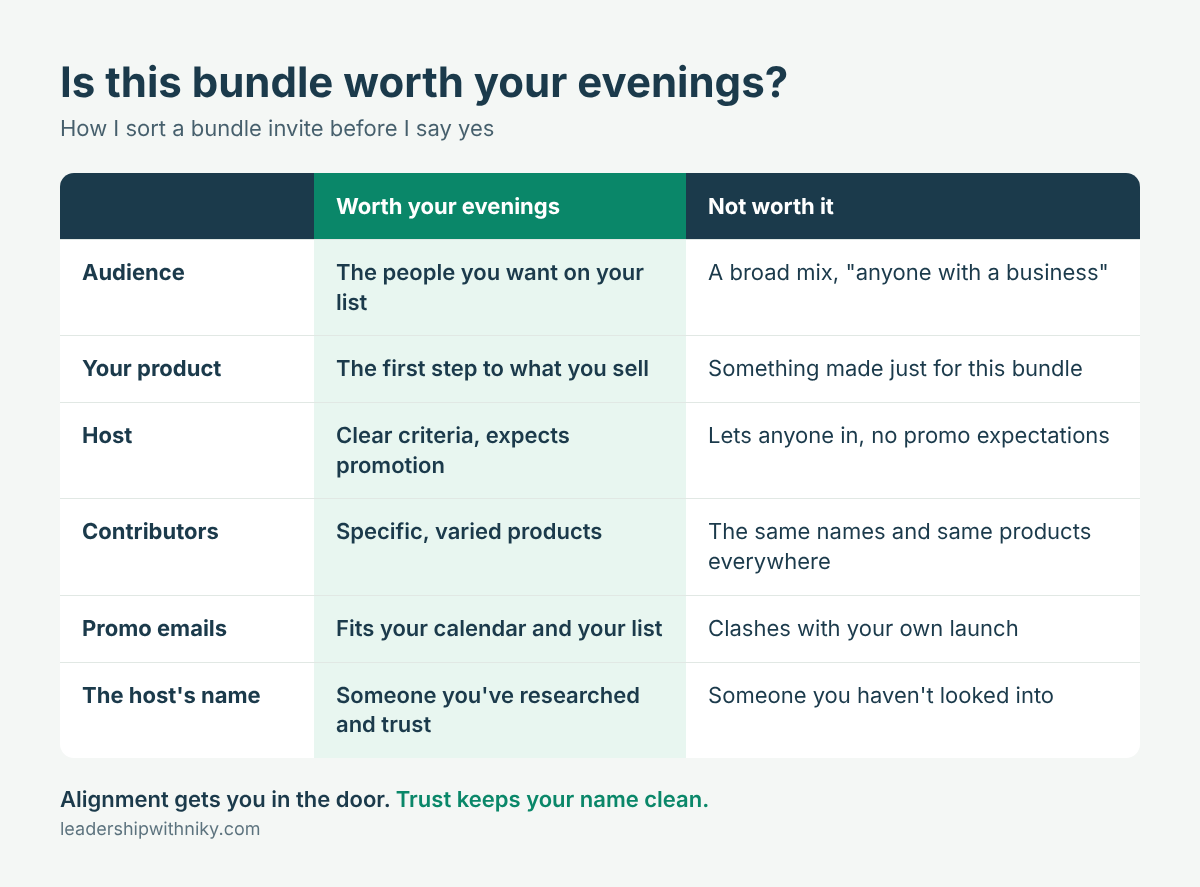
Alignment gets you in the door. Trust is what keeps your name clean.
What's the first step to choosing which bundles to join?
Before your next invite arrives, write one sentence: "I want [type of person] on my list because I sell [offer]." Then hold every bundle invite up against it.
If the bundle's audience doesn't match that sentence, it's a no, or at least a slower yes. If the product you'd contribute doesn't lead to that offer, choose a different one or skip it. Then research the host and check the promo dates against your calendar.
I'm much pickier now about when I contribute and what I put in, and my list is better for it.
If you'd like a fuller check, I built the Collaboration Filter after saying yes to bundles that weren't aligned enough. It scores a bundle invite out of 10 and gives you a clear yes or no before you commit your evenings.
For the bigger picture of building around a job, read my guide to starting a business while working full time.
FAQs: Are Bundles Worth It?
Q: How do bundles work for contributors?
A: A host puts together a collection of products from many business owners and runs it for a short time. As a contributor, you apply, give a product (usually one you'd normally sell), and send a set number of promo emails. People who claim your product join your email list, so you grow your list from everyone's promotion.
Q: Are bundles worth it for small businesses?
A: Bundles are usually worth it for growing an email list and meeting other business owners, but they're slow for sales. Expect a wave of unsubscribes in the first couple of weeks. They work best when the bundle's audience matches yours, your product leads to what you sell, and the host expects every contributor to promote.
Q: Do you get paid for contributing to a bundle?
A: Usually not directly. Most contributors take part to grow their email list, not for a fee. If you have the right setup behind your product, like a tripwire or an order bump (an add-on offered at checkout), you can make sales from the new subscribers. Some large bundles also sell paid sponsor spots that put you at the top of the bundle page, where people see you first. I've had sponsor spots that were worth it and ones that were wasted money, so check the bundle's audience before you pay.
Q: Is a bundle contributor agreement legally binding?
A: A written agreement can be legally binding, depending on what it says and where you are. Bundle terms usually set out what you're agreeing to, such as how many promo emails you'll send and how subscriber details can be used. This is general information, not legal advice. For anything involving money or your intellectual property, talk to a lawyer.
Choose the audience, and the list follows
You don't need to say yes to every bundle to grow. You need bundles where the audience is yours, your product leads somewhere, the host is someone you trust, and the promo emails fit your calendar.
I learned that by doing it backwards. You can start the right way round, by getting clear on who your business is for before the next invite lands.
If you're still working that out, my free framework walks you through finding the business in the skills you already have, step by step, with a workbook and a video walkthrough.
👉 Get the free From Job to CEO Framework
What's the best bundle you've contributed to, and what made it work? Come and tell me in the free From Job to CEO community on Skool.