
How to Start a Business Without Burning Out
Want to start a business without burning out while working full time? It's not the hours that break you, it's having no limits. Here's what I changed.
Last updated: 20 November 2026
I didn't know I had shingles. I just knew I couldn't sleep, I had a sore spot on my side, and I didn't have time to deal with it.
At the time I was working full time, looking after two kids, up early six days a week to exercise, and building my business every night. I felt guilty when I worked on it, and guilty when I missed the kids' things because of it. When I finally described my symptoms to my husband, he knew straight away. I was at the doctor getting antivirals that same day.
Here's the short answer I wish I'd had then. You start a business without burning out by building it with limits from day one: a set number of hours a week, one experiment at a time, a hard shutdown time, and a date to check in. Burnout usually doesn't come from the hours alone. It comes from treating the business like a second full-time job with no off switch.
Below is why it happens, the signs I missed, what I do now, and one step you can take this week.
Why do people burn out when they start a business?
People burn out starting a business because they add a second job to their life without taking anything away or setting any limits. The business gets every spare hour, and nothing tells them when to stop.
Most of us start already stretched. Gallup's State of the Global Workplace 2026 report, based on 2025 data from more than 141,000 employed people, found 40% of employees worldwide felt a lot of stress the previous day, and 50% in the United States and Canada (Gallup's State of the Global Workplace data). That's before anyone opens a laptop at 8pm to work on their own thing.
Look at the advice online and it doesn't fit either. It's written for founders who can "hire a COO", or it's general wellness tips about sleep and water. None of it is written for someone holding down a demanding job while they build something on the side. That person needs limits, not a longer list of self-care.
What does side hustle burnout actually look like?
Side hustle burnout, the exhaustion that builds when a side business runs on top of a full-time job, often shows up as scattered work before it shows up as tiredness. For me, the first sign is always the same.
When I'm tired and keep pushing, I go a bit all over the show. I start everything and finish nothing. I'll open five tabs, half-write an email, tweak a sales page, then realise two hours have gone and nothing is done.
Other signs I've learned to watch for:
Lying awake running through the business to-do list
Feeling guilty whether I'm working on the business or not
Ignoring my body because "there's no time to be sick"
Dropping the things that normally keep me well
That last one was the shingles. I didn't stop. I barely took time off even once I was diagnosed. I did take a few days, and I tried to step it back a bit, but I didn't change much until later.
This is my experience, not medical advice. If you're unwell or can't shake the exhaustion, see your doctor.
Why doesn't "hustle now, rest later" work?
"Hustle now, rest later" doesn't work because later doesn't come. There's always another launch, another client, another week that feels too important to slow down.
I grew up believing you work hard to get ahead, and that if something isn't hard, maybe it isn't worth much. That belief built my career. It's also why stepping back and listening to myself is genuinely hard for me.
But I don't think you need to buy into hustle culture to build a business. I'm not against hard work. I'm against the performance of it: the always-on, always-available theatre that looks impressive and quietly costs you your health.
I finished an undergraduate degree and a Masters of Entrepreneurship while working full time. Neither happened by grinding around the clock. They happened in focused, protected blocks. My business is built the same way, on most days.
Why do new business owners say yes to every job?
New business owners say yes to everything because every job feels like it might be the last one for a while. So they take it, and the next one, and the one after that.
It's a pattern I've watched up close in people I love. You take every job and every client because what if nothing else comes in? Then you look up and you've worked every single day for two weeks straight. Switching off gets harder because the pressure to earn never really leaves.
If you're building on the side, the same thing happens in smaller pieces. Every evening becomes a work evening. Every weekend has "just an hour" in it. Fear of missing an opportunity quietly turns into no days off at all.
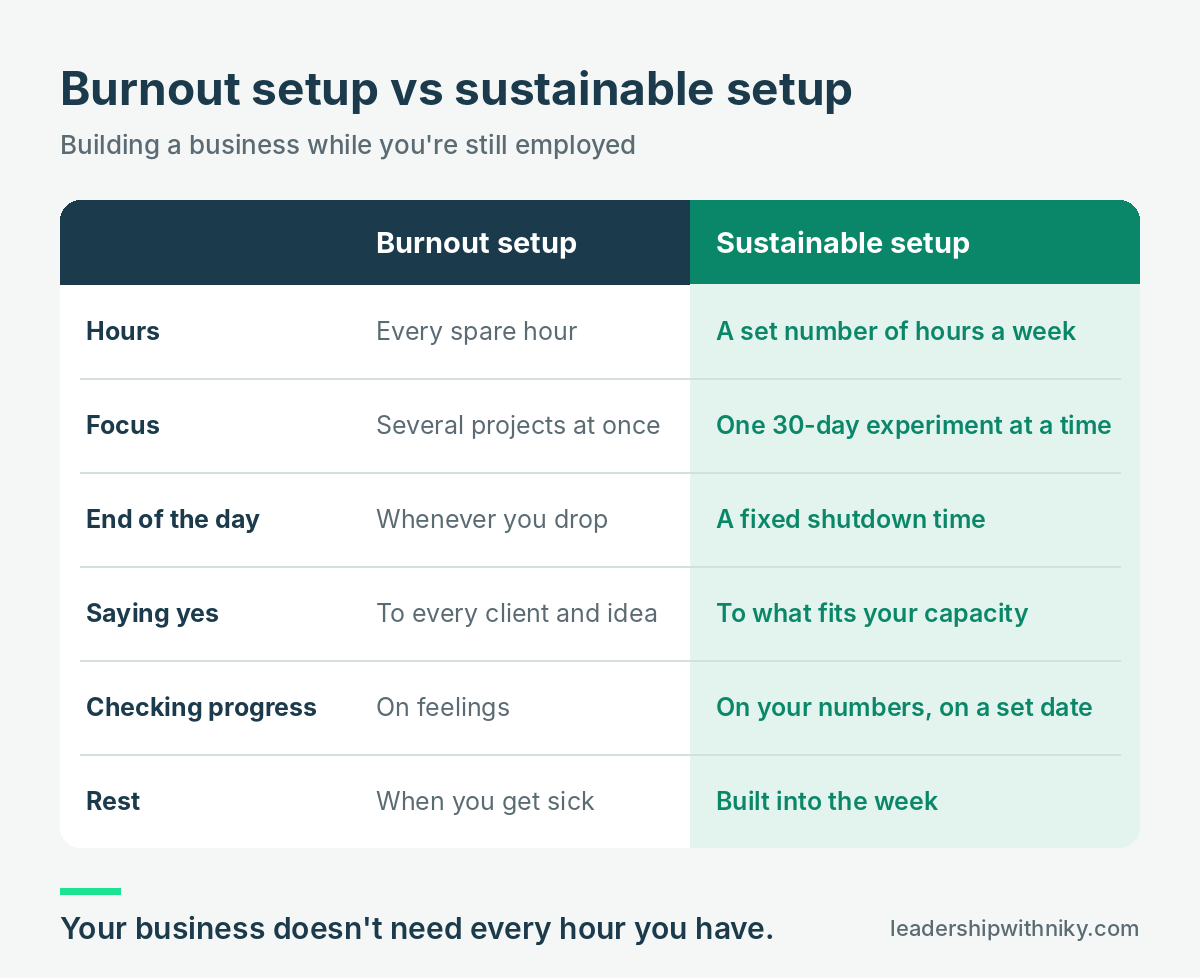
Here's the difference between the two setups:
Burnout setup | Sustainable setup | |
|---|---|---|
Hours | Every spare hour | A set number of hours a week |
Focus | Several projects at once | One 30-day experiment at a time |
End of the day | Whenever you drop | A fixed shutdown time |
Saying yes | To every client and idea | To what fits your capacity |
Checking progress | On feelings | On your numbers, on a set date |
Rest | When you get sick | Built into the week |
How many hours a week should you work on a business while employed?
Work the number of hours you can keep in a bad week, not the number you can manage in a good one. For many employed people, that's somewhere around 5 to 8 focused hours a week.
There's no magic number. What matters is that it's a number. If you don't decide your weekly capacity, the business will decide it for you, and it'll take everything.
It also helps to be realistic about the pace. Bankrate's 2025 survey of 2,616 US adults found the median side hustle brings in about $200 a month (Bankrate's 2025 side hustle survey). Most side businesses are a long game. A pace you can keep for a year beats a pace that breaks you in three months.
If your evenings are where the hours have to come from, I've written about how to work on your business when you're tired after work, including matching tasks to how much energy you've got left.
How do you build an off switch into your week?
Build your off switch into your phone and your calendar, so stopping doesn't depend on willpower at 10pm. Mine is a set time, not a feeling.
At 9:30pm, my watch puts my phone messages into sleep mode. I try really hard to be in bed by 10pm. And I don't work late in my 9-to-5, so the time between work and the kids' bedtime is family time.
Am I perfect at this? No. I work a lot on my business, and I could do better. My current build is a small team of AI employees to take some of it off me.
The off switch matters during the day too. If your job is already taking your best energy before you get home, start there. I've shared how I stop my job draining my energy during the work day.
Your business doesn't need every hour you have. It needs the hours you planned to give it.
How do you stop doing everything and finishing nothing?
Pick one thing to test for 30 days and park everything else. Doing five projects at half strength is one of the fastest ways to feel busy and burnt out at the same time.
This is exactly why I run my business in small 30-day experiments. One focus, one way to measure it, one date to look at the results. When the month ends, I decide what's next based on what the numbers showed, not on how tired or excited I feel.
It also gives me a way to catch myself. When I notice I'm going all over the show again, starting everything and finishing nothing, I take it as a signal to pull back. Scattered work is usually tiredness in disguise, not a lack of discipline.
What's the first step to starting a business without burning out?
This week, set one shutdown time for your business work and put it in your phone. That's the whole step.
Pick a time that leaves you enough sleep. Set your phone's sleep or focus mode to start then, so messages go quiet automatically. When it kicks in, you stop, even mid-task. Write down where you got to so tomorrow's start is easy.
At the end of the week, notice how you slept and how much you actually finished. Most people find they get just as much done, with less of the scattered, half-finished work.
If you're still working out whether to build a business around your job at all, start with my guide to starting a business while working full time.
FAQs: Starting a Business Without Burning Out
Q: How many hours a week should I work on my business if I have a full-time job? A: Choose the number of hours you can keep in a hard week, not your best week. For many employed people, that's around 5 to 8 focused hours. The exact number matters less than deciding it in advance, so the business doesn't quietly take every spare evening and weekend.
Q: How do you avoid burnout as a business owner? A: Set limits before you need them: a weekly hours number, a daily shutdown time, and one main focus at a time. Check progress on a set date using your numbers rather than how you feel. And treat early warning signs like poor sleep or scattered work as a reason to pull back.
Q: Is it okay to quit your job because of burnout? A: It can be, but it's worth getting support before deciding on your worst day. Talk to your doctor, and your workplace Employee Assistance Programme (EAP), a free, confidential counselling service many employers offer. If you're also building a business, check whether it can cover your costs before you rely on it. This is general information, not financial or medical advice.
Q: What kind of business can you run alongside a full-time job? A: One you can test in small, scheduled blocks of time, usually built on skills you already use at work. Services, templates and short workshops tend to fit better than businesses needing stock or long hours. I've written about how to turn the skills from your job into income.
Q: Is it true that 90% of startups fail? A: No, not according to US government data. The US Bureau of Labor Statistics found that of private-sector business establishments opened in 2013, 79.6% were still operating a year later and about half after five years (US Bureau of Labor Statistics survival data). Survival is hard, but 90% is a myth.
A business that costs you your health isn't freedom
You don't need to choose between building a business and looking after yourself. Decide your hours, keep one focus, set a shutdown time and check your numbers on a set date.
Hard work still matters. It just needs limits around it, so the business you're building fits around your life instead of eating it.
If you want help setting those limits, my free Boundary Rescue Pack helps you set good boundaries and protect your energy all day, not just at the end of it.
👉 Get the free Boundary Rescue Pack
What's your shutdown time, or what's stopping you from having one? Come and tell me in the free From Job to CEO community on Skool.