
How to Choose the Right Business Idea to Test First
How to choose the right business idea with a job: set one big goal, pick the idea that moves you closest, test it for 30 days and park the rest.
Last updated: 13 November 2026
I have never been short of business ideas. Reselling designer clothes, a handbag line, a protein bar, a leadership YouTube channel. Some stuck. Most didn't.
I've always been energised by the new thing, and honestly, I still am. Most weeks I think of something I'd love to try. What's changed is how I choose.
Here's the short answer. To choose the right business idea, start with one big goal, then pick the idea that moves you closest to it and that you can test in the next 30 days with the skills and hours you already have. Every other idea goes in a parking bay, not the bin.
Below is why "follow your passion" makes choosing harder, how I choose between my own ideas (including the one I've already picked for my next experiment), a simple way to compare two ideas, and one step you can take tonight.
How do you choose the right business idea when you have too many?
Choose the idea that gets you closest to your one big goal, not the one that feels most exciting today. Without a goal to measure against, every new idea looks equally good, so you end up choosing on mood.
My big goal is simple: grow my business until it can support me without a job. Every idea I have now gets held up against that one sentence.
That changed how I work. Before I had it, choosing between ideas felt like choosing between equally shiny things. With it, most ideas sort themselves in seconds. Does this get me closer, or does it just feel good to start?
If you don't have a big goal yet, write that first, before you look at your list of ideas. It can be as plain as "replace my salary by the end of next year" or "earn enough to drop to four days a week".
Why is "follow your passion" bad advice for choosing a business idea?
"Follow your passion" makes choosing harder, because it tells you to choose on feeling, and feelings change the moment the work gets difficult. It sounds lovely. It's also the advice I'd argue with most.
There's research behind this. Paul O'Keefe, Carol Dweck and Gregory Walton at Stanford University ran five experiments with 470 people and found that those who believed interests are simply waiting to be found lost interest faster once the material got hard. Their 2018 paper for Psychological Science suggests passion is developed through effort, not discovered (Stanford's report on the 'find your passion' research).
There's a practical problem too. Turn your hobby into your job and you need a new hobby. The thing you did to switch off now comes with customers, deadlines and invoices.
Passion is a nice bonus. It's a poor filter. I'd rather choose an idea I'm interested in that fits my goal than one I love that doesn't.
What does choosing a business idea by your goal look like in real life?
Choosing by your goal means even the fun ideas have to earn their place by moving you towards your main goal. Here's a real example from my own business this month.
I'm running The Great Escape in my free Skool community right now. It's a free game, a play on escaping your boss, with clues to crack. It's genuinely fun, and I wanted something engaging for the group.
But fun isn't why I chose it. I chose it because it grows my community and my email list, which grows my business, which gets me closer to not needing a job. The game is the wrapper. The goal is the reason.
That's the test every idea gets now. A fun idea that also moves my main goal goes ahead. A fun idea that doesn't goes in the parking bay, however much I'd enjoy it.
How do you use evidence to choose your next business idea?
Your last experiment is the best guide to your next one, because it shows you what actually happened instead of what you hoped would happen. That's how I've already chosen my next 30-day experiment.
In my very first experiment, a Meta ad sent 1,634 people straight to my Skool community page in a week, and one of them joined. Ads went on the shelf.
With The Great Escape, I tried ads again with one change. Instead of sending people straight to Skool, the ads sent them to a sign-up page on my own website to get the game by email first. Far more people signed up, and they joined my email list, which matters more to my business than a community join.
My best guess at why: joining a community is a bigger ask from a stranger than giving an email address. Same tool, different setup, very different result.
So my next experiment, starting in December, is ads again, sending people to a free resource with a small, low-priced offer straight after it (often called a tripwire). It will cost money, and I've chosen it because the evidence says it's worth testing.
How do you decide between two business ideas?
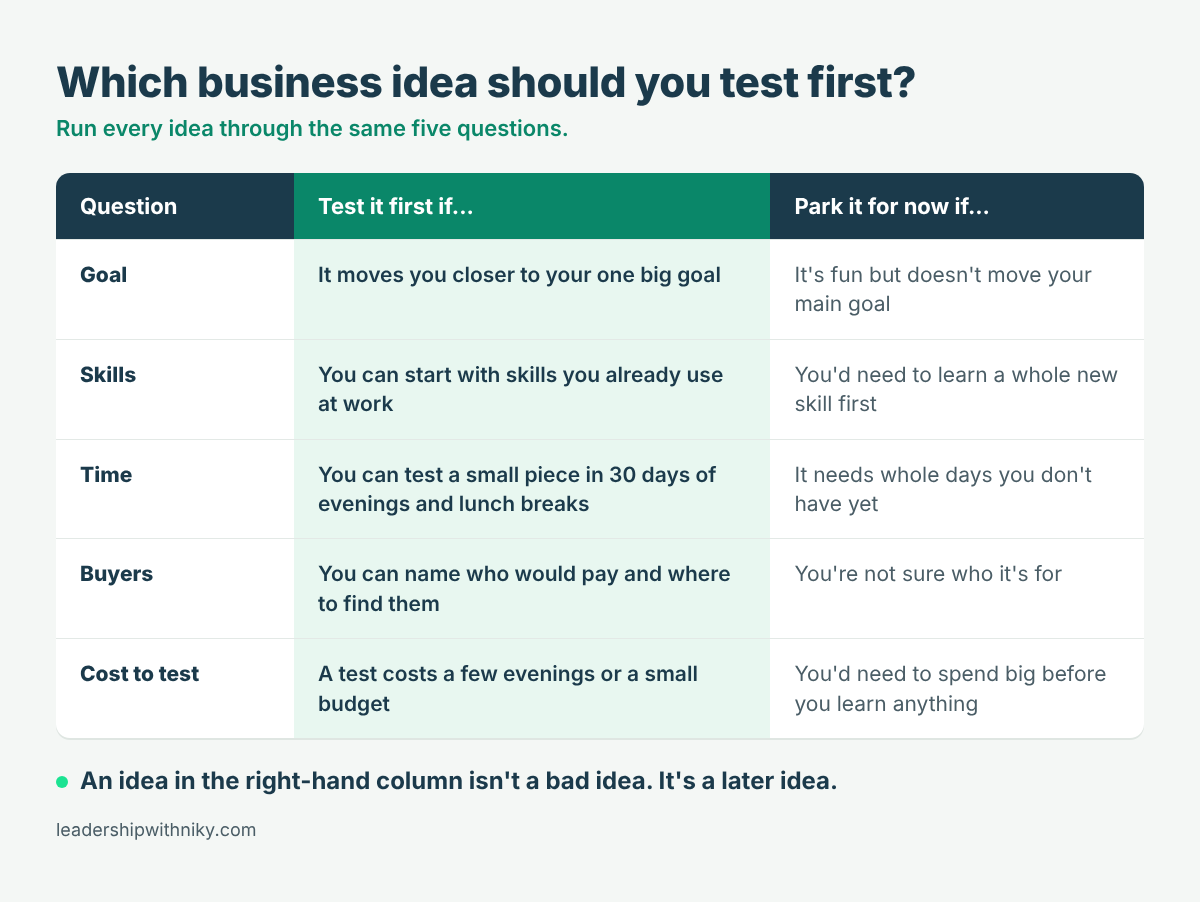
To decide between two business ideas, run both through the same few questions and choose the one that wins on goal fit and on how quickly you can test it. The one you're most excited about doesn't get bonus points.
Question | Test it first if... | Park it for now if... |
|---|---|---|
Goal | It moves you closer to your one big goal | It's fun but doesn't move your main goal |
Skills | You can start with skills you already use at work | You'd need to learn a whole new skill first |
Time | You can test a small piece in 30 days of evenings and lunch breaks | It needs whole days you don't have yet |
Buyers | You can name who would pay and where to find them | You're not sure who it's for |
Cost to test | A test costs a few evenings or a small budget | You'd need to spend big before you learn anything |
An idea in the right-hand column isn't a bad idea. It's a later idea.
If you're not sure which of your skills count, start with how to turn the skills from your job into income. Most people undersell the things they do every day at work.
What's the biggest mistake people make when choosing a business idea?
The biggest mistake is going all in on an idea before checking whether anyone actually wants it. An idea can make perfect sense in your head and still have nobody waiting to buy it.
This happens to well-funded companies too. CB Insights' 2026 analysis of venture-backed startups that shut down since 2023 found 43% of those with an identifiable cause had poor product-market fit, meaning not enough people wanted what they built (CB Insights' 2026 report on why startups fail).
Those companies had teams and funding. If it can happen to them, it can happen to an idea you've only tested in your own head.
Before you commit, ask who would buy it and how you know. "I think they'd love it" isn't evidence. A reply, a sign-up or a sale is. I walk through how to get that evidence in how to test a business idea in 30 days without quitting.
What should you do with the business ideas you don't choose?
Park the ideas you don't choose somewhere you can see them, so they stop pulling at your focus without being lost. Not choosing an idea doesn't mean deleting it.
I keep a parking bay in my CEO Dashboard for exactly this. When a new idea turns up halfway through an experiment, it goes in the parking bay. It doesn't unravel what I'm working on, and I know exactly where to find it later.
The point is getting it out of your head. An idea in the parking bay is safe. An idea rattling around your head is a distraction. A page at the back of a notebook or a note on your phone works too.
When your current experiment ends, open the parking bay and hold each idea up against your big goal again. Some will look better than you remembered. Some will make you wonder what you were thinking.
What if every new business idea feels exciting?
If every idea feels exciting, the excitement isn't telling you anything, so let your goal decide instead. New ideas feel good because they're new, not because they're right.
I've been sidetracked by new and shiny things more times than I'd like to admit. It almost always happened when I'd lost sight of what I was actually aiming for. I suspect most people building something alongside a job have done the same.
The fix isn't to stop having ideas. Ideas are a good sign. The fix is giving every idea a place to land and one question to answer: does this help my goal, or does it just help me feel like I'm moving?
If the answer is the second one, that's fine. Write it down, park it, and get back to the experiment you're already running.
What's the first step to choosing the right business idea?
Write your one big goal in a single sentence, then ask every idea one question: will this get me closer to that goal in the next 30 days? It takes about 20 minutes and a notebook.
Write your big goal. One sentence, as plain as you can make it.
List every idea you're carrying around. All of them, including the ones you'd be embarrassed to say out loud.
Ask each idea the question. Circle the one that gets the clearest yes.
Park the rest. Somewhere you'll see them again, not somewhere you'll forget them.
Turn the circled idea into a 30-day test. Decide before you start what number counts as a yes.
If you'd rather not do this alone, The Starting Line is where I do it with you: I check whether your idea can work and set up the first experiment worth running.
If you're doing all of this alongside a full-time job, my guide to starting a business while working full time covers the bigger picture. And once your test shows people want it, check the money side with how to know if a business idea is profitable.
FAQs: How to Choose the Right Business Idea
Q: What is the best way to validate a business idea? A: Run a small, time-limited test with real people before building the whole thing. Decide in advance what number counts as a yes, such as replies, sign-ups or sales, then track what people actually do for 30 days. What people do tells you far more than compliments or "I'd buy that".
Q: How do I know which business idea is worth my time? A: An idea is worth your time when it moves you towards your main goal, uses skills you already have, and can be tested in the hours you actually have. If it misses all three, park it for later. Once it passes a test, check it's profitable with your hours counted.
Q: What business should I pursue? A: Pursue the idea you can test now with what you already know, not whatever tops a "best business ideas" list. Those lists don't know your skills, your hours or your goal. Your own work experience usually holds a better starting point than someone else's trend.
Q: How do you decide between two business ideas? A: Compare both against the same questions: goal fit, skills, time, buyers and the cost to test. Choose the one that wins on goal fit and is quickest to test, run it for 30 days, and keep the other in a parking bay. The results often make the second decision for you.
Pick one. Park the rest.
You don't have to choose the business you'll run for the next 20 years. You only have to choose what to test for the next 30 days, using your goal to decide instead of your mood.
Your ideas aren't the problem. Choosing without a goal is.
If you're not sure which of your ideas are worth testing yet, my free framework helps you find the business hiding in the skills and experience you already have, with a workbook and a video walkthrough.
👉 Get the free From Job to CEO Framework
What's the one big goal you're choosing your ideas against? Come and tell me in the free From Job to CEO community on Skool.