
How Much Should Your Business Make Before You Quit Your Job?
How much should your business make before you quit? More than your take-home pay. Count what your employer covers and decide if you need to match it.
Last updated: 23 October 2026
During my Masters of Entrepreneurship, I had a slightly embarrassing habit. Whenever I needed motivation, I'd open a spreadsheet and work out how far I was from being able to quit my job. Then I'd change one figure and run it again.
I did that formula more times than I'd like to admit. Every time, I was looking for the version where the gap closed faster.
So how much should your business make before you quit? More than your take-home pay. Your business needs to bring in enough, month after month, to cover your pay before tax, everything your employer quietly adds on top, and your business costs. The popular rules of thumb range from two-thirds of your salary to nearly double it, because they're answering different questions.
Below is what your job is really paying you, why the rules disagree, the second number most advice mixes in with the first, and why you might not need to match your salary at all.
Why isn't your take-home pay the right target?
Your take-home pay is the wrong target because it's what's left after your employer has already paid for a lot of things on your behalf. Tax comes out before you ever see it, and the leave, retirement contributions and insurance your employer funds never land in your bank account at all.
This is the most common mistake I see. Someone looks at the amount that arrives each payday, decides that's what the business needs to make, and starts the countdown.
But when you work for yourself, nobody deducts your tax for you. Every dollar your business earns arrives before tax, and some of it has to be set aside. The number on your payslip that matters is the one at the top, not the one at the bottom. Then you add what your employer pays on top of it.
What does your employer pay for that you'd have to cover yourself?
Most employers pay for things on top of your salary, such as retirement contributions, insurance and paid leave, and you'd fund every one of them yourself once you quit. The surprise usually isn't the big items. It's the ones you'd stopped noticing.
For me, it wasn't the retirement savings that came out of my own pay. It was what my employer added on top: nearly 8% extra toward my superannuation (a retirement savings scheme), plus 60% of my health insurance. To keep the same cover and the same buffer at retirement age, I'd need to pay both in full.
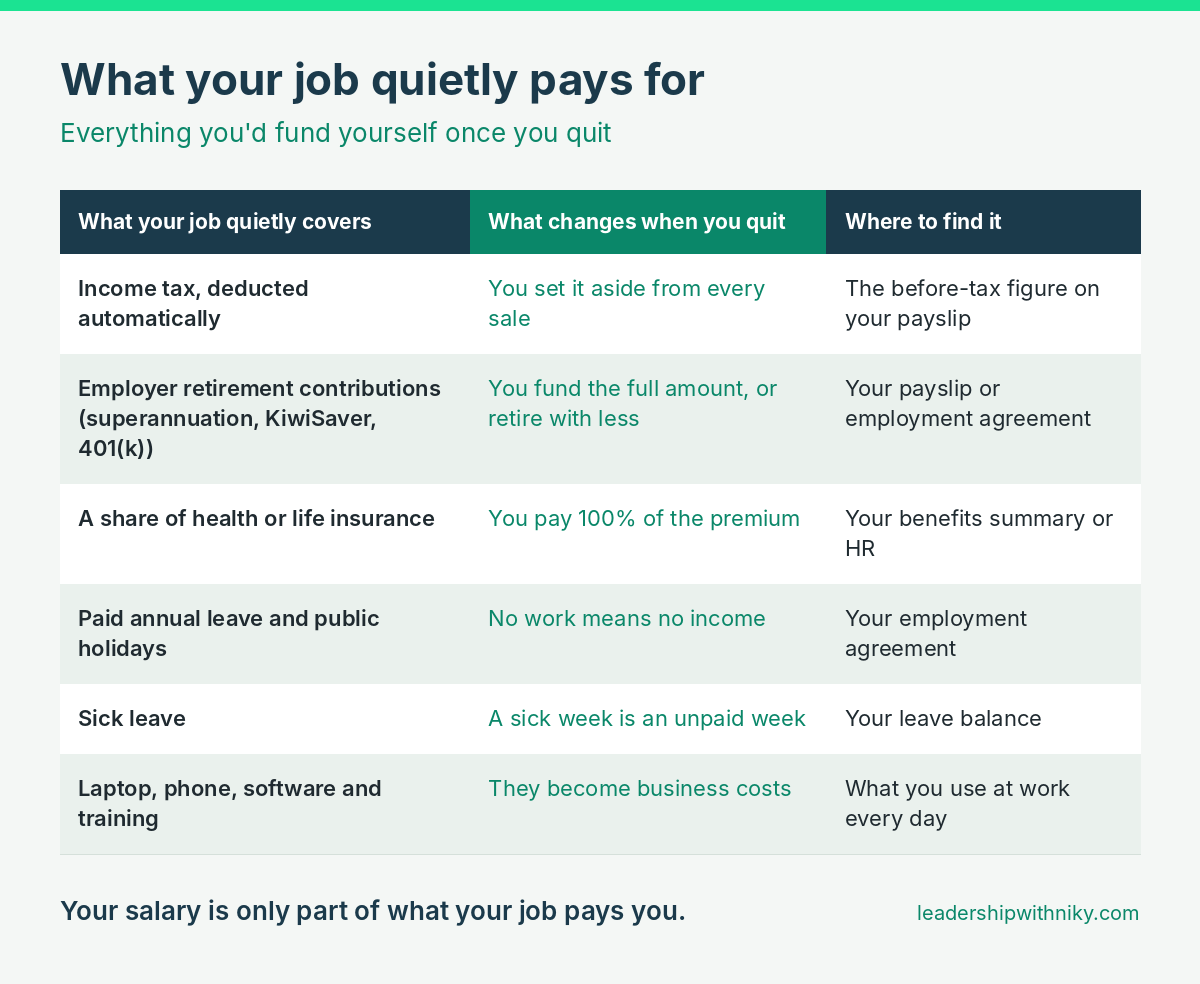
What your job quietly covers | What changes when you quit | Where to find it |
|---|---|---|
Income tax, deducted automatically | You set it aside from every sale | The before-tax figure on your payslip |
Employer retirement contributions (superannuation, KiwiSaver, 401(k)) | You fund the full amount, or retire with less | Your payslip or employment agreement |
A share of health or life insurance | You pay 100% of the premium | Your benefits summary or HR |
Paid annual leave and public holidays | No work means no income | Your employment agreement |
Sick leave | A sick week is an unpaid week | Your leave balance |
Laptop, phone, software and training | They become business costs | What you use at work every day |
Your salary is only part of what your job pays you.
Why is leave the cost nobody counts?
Leave is easy to forget because it only feels valuable when you need it, and by then it's too late to build it up. I learned this one the slightly painful way.
When I left my last employer, I walked away with over 70 days of sick leave I'd never used. A few months into my new role, I needed an unexpected operation. Insurance covered the operation. It didn't cover the time off.
I was using leave I hadn't built up yet, while 70 days sat unused at a job I'd just left. In your own business there's no leave balance at all. Every week you're sick, or simply need a break, is a week your business has to have already paid for.
Why do the rules of thumb for quitting your job disagree?
The popular rules disagree because some measure what you need to live on, and others measure the full value of your job. Neither is wrong. They're just answering different questions.
Foundr's guide to when to quit your job points out that some people say you need two-thirds of your salary and others say all of it, then argues you should set your own number instead. Financial Samurai founder Sam Dogen, a former investment banker, estimates a typical US job is worth about 1.3 times the salary once benefits are counted, and that a business owner needs to earn 30% to 60% more to come out even (Financial Samurai's breakdown of business income vs a day job).
Rule you'll hear | What it's really measuring | Who it suits |
|---|---|---|
Two-thirds of your salary | Enough to live on if you cut back | People happy to live leaner for a while |
100% of your salary | Your current pay, before benefits | A rough first target |
1.3 to 2 times your salary | Pay plus benefits, tax and business costs | Matching your job like for like |
A rule of thumb is someone else's average. Your number comes from your own payslip.If you want to work yours out properly,From Salary to Sales calculates your true employment value from your own figures and shows the gap your business needs to close.
Do you actually need to match your salary before you quit?
Not always. If you earn well, matching your salary like for like can set the bar so high that it keeps you stuck. This is the flip side of everything above, and nobody talks about it.
The further along your career, the steeper the hill. A good salary can make you comfortable enough not to push, and the gap can look so big that it's discouraging before you've really started. It can also make you overestimate what you need, because you're trying to match your current lifestyle rather than cover your actual life.
Foundr makes a similar point: you might need far less than you earn now to live well. Some people quit earlier, live on less for a while, cut back on things like nights out, and then grow faster because the business finally gets their daytime hours.
That's a valid choice, as long as you've made it with numbers, not in a huff.
How much money should you have saved before you quit your job?
Before you quit, you need a second number: savings to live on while your business income settles. Most advice blends this into one figure with your income target. They're two different things.
Your quit number is what the business needs to bring in each month. Your runway is how long you can manage if it doesn't, at least at first. The further your business is from its quit number, the longer your runway needs to be.
Foundr recommends saving at least six months of living costs. Financial Samurai's advice is to stay employed until your business covers your basic expenses for six months in a row. Both are general guidance, not financial advice, so talk to a financial adviser about your own situation.
One number tells you when the business is ready. The other tells you how much room you have if it takes longer than you hoped.
What happens when people quit before they're ready?
People who quit before they've worked out their numbers often spend their first months stressed about having no income, instead of building the business. I've heard plenty of these stories in my Skool community and the other business groups I'm part of.
Sometimes leaving is the right call regardless. If staying in a job is putting your health at risk, that changes everything, and every situation has its own nuance. But I've also watched people leap without really working it out, and then the business had to pay the bills before it was ready to.
What I want, for you and for me, is to leave excited about what's next and sure it's time. Not desperate, not in a huff and not cutting all ties on a hope. Fed up is a feeling. Ready is a number.
If you'd like your exit worked out clearly before you make that call, that's what The Starting Line is for. You fill in one form, and I send back your exit number, whether your business can reach it, and your first 30-day experiment to get you moving.
Why is keeping your job an advantage while you close the gap?
While you're still employed, your salary lets you take bigger risks with your business than you could if it had to pay the bills. I remind myself of this whenever I'm frustrated about how little time I have.
Because my job covers the basics, I can afford to lose a little money testing whether something speeds the business up. I've done exactly that, paying for tools and other people's expertise so I move faster than a couple of hours a night would allow. Honestly, I kind of have to, if I want to get there sooner than trotting along at evening pace.
People who build while employed are also less likely to see their business close, which I cover in my guide to starting a business while working full time. Your job isn't the thing standing between you and your quit number. Right now, it's funding the climb.
What's the first step to working out how much your business should make before you quit?
This week, get out your latest payslip and employment agreement, and list everything your employer pays on top of your take-home pay. Tax, retirement contributions, insurance, leave and equipment. It takes about 20 minutes.
Then write down two numbers: your essential monthly living costs, and how many months of those you have saved. Together they show how far away you are and how much breathing room you've got, without guessing.
Turning that list into one monthly target is the part that takes a proper calculation. There are two ways to do it:
Work it out yourself: From Salary to Sales is the spreadsheet I built at my own kitchen table to calculate my number, including everything my employer pays on top.
Have it worked out for you:with The Starting Line, I run your numbers for you, check whether your business can reach that target, and design your first 30-day experiment to start closing the gap.
And if you're not sure your idea could reach that number at all, start with how to know if a business idea is profitable before you build it.
Trust what you know about your own numbers. Then test them.
FAQs: How Much Your Business Should Make Before You Quit
Q: How much money do I need to quit my job and start a business?
A: You need two numbers. The first is monthly business income that covers your pay before tax, what your employer adds on top, such as retirement contributions and insurance, and your business costs. The second is savings to live on while that income settles. This is general guidance, not financial advice.
Q: How much money should I have saved before quitting my job?
A: Many guides, including Foundr, suggest at least six months of essential living costs, and more if your business is still far from its income target. Count essentials like housing, food, insurance and debt payments rather than your full lifestyle. A financial adviser can help you set a figure for your own situation.
Q: Should I quit my job to start my own business?
A: Usually not until your business has a repeatable way to make sales and you know your numbers. Research by Raffiee and Feng (2014) found people who built a business while still employed had a 33% lower risk of it closing. Some people keep their job for good, and that's a valid outcome too.
Q: When should you quit your job for your side hustle?
A: Quit when your business has covered your quit number consistently for several months, not after one good month, and you have savings to fall back on. Leave because the numbers say it's time and you're excited about what's next, not because you're fed up with your job.
Know your number before you hand in your notice
You don't need to quit the day your business matches your payslip. You need to know what your job is really paying you, decide whether you actually need to match it, and have a runway for the months in between.
Then your countdown is based on a number, not a hope.
If you're still working out which of your skills could get you there, my free framework walks you through finding the business hiding in the work you already do, step by step, with a workbook and a video walkthrough.
👉Get the free From Job to CEO Framework
What's one thing your employer pays for that you'd forgotten about until now? Come and tell me in the free From Job to CEO community on Skool.