How to Know If a Business Idea Is Profitable (Before You Build It)
How to know if a business idea is profitable: work out what each sale leaves after costs and your hours, then test feasibility properly before you build.
Last updated: 23 October 2026
For nearly a year, I made two long-form YouTube videos a week. Research and scripting, filming in batches, about three hours of editing per video, then upload and schedule. Around 10 hours a week, on top of a full-time job and two kids.
I never once did the maths on whether it could make money.
Here's the short answer I wish I'd had back then. To know if a business idea is profitable, work out what one sale leaves you after costs and the hours it takes, then check how many sales you'd need for it to be worth it. People wanting your idea is one test. Making money from it is a separate test, and it's the one most of us skip.
Below is the difference between demand and profit, the YouTube maths I should have done first, the cost almost everyone forgets, a quick first check you can run this week, and what a proper feasibility check adds before you build.
What does it mean for a business idea to be profitable?
A business idea is profitable when the money it brings in is more than everything it costs to deliver, including your time. Revenue is the money customers pay you. Profit is what's left after costs like platform fees, software, materials and advertising come out.
That sounds obvious until you're the one building. Revenue is loud: a sale notification, a payout, a number going up. Costs are quiet. They hide in subscriptions, the course you bought to learn how, and the evenings you spent making the thing.
This is why demand and profit are two different tests. In how to test a business idea in 30 days without quitting, I covered checking whether people actually want your idea. Profit asks the next question: if they do buy, does each sale leave you anything worth having? An idea can pass the first test easily and still fail the second.
Why can a business people love still lose money?
A business people love can still lose money when each sale costs more to deliver than the customer pays. The best-known example is MoviePass, the US cinema subscription that took off in 2017.
MoviePass charged $9.95 a month to see a movie at the cinema every day, in cities where one adult ticket cost $15 to $20 (NBC News on how MoviePass collapsed). MoviePass paid the cinemas for those tickets, and the cinema chain AMC said publicly it would lose money on every subscriber who saw two or more movies a month.
Customers loved it, and that was the problem. Every extra happy customer cost the company more. It cut subscribers back to three movies a month, its app kept breaking, and the service shut down in 2019. Michael Pachter of Wedbush Securities summed it up as "selling dollars for nickels."
As someone who works with a movie playing in the background most nights, I'd have signed up on day one. Popularity isn't profit. Sometimes it's the thing that sinks you.
What happened when I didn't check if my idea would make money?
I spent close to a year and roughly 500 hours on a YouTube channel before I ever worked out what it would need to earn. It was a leadership channel, and the plan was for it to build an audience for my leadership course.
I started with one long-form video a week, bought a YouTube course for about $2,000 to learn how, then stepped up to two videos a week for almost a year. Each video took an hour or two of research and scripting, filming in batches of two or three, and around three hours of editing. I found a faster way to edit, cutting from the script first and letting the software remove the pauses, but it was still a huge job.
The channel reached around 400 subscribers, and almost nobody bought the course, partly because most people get leadership training free through work. And because I'd turned the whole thing into a schedule I found boring, my videos were a bit boring too.
The maths I should have done first
At 400 subscribers, YouTube ads were never going to pay me anything, let alone replace an income. A channel can't earn any ad money until it joins the YouTube Partner Program, which needs 1,000 subscribers and 4,000 watch hours. After that, creators get 55% of the ad revenue on long-form videos (YouTube's own guide to the Partner Program).
vidIQ's 2026 data puts most creators at $1 to $5 per 1,000 views, and finance and business channels at $4 to $12 or more (vidIQ's 2026 YouTube pay rates). Say I wanted YouTube ads to bring in US$10,000 a month. Even at a business-niche $8 per 1,000 views, that's about 1.25 million views a month, or roughly 145,000 views on every video at two a week. vidIQ puts that in the range of channels with around 100,000 subscribers.
I had 400. I needed roughly 250 times the audience, and I'd never written that number down.
Why is your own time the cost most people forget?
Your own time is the cost most people leave out, because it never arrives as a bill. If you're building around a job, it's also your scarcest resource, and once an evening is spent, you can't get it back.
The thinking usually goes like this: I can do it myself, so it's free. Design the logo, build the website, edit the videos, learn the tech from YouTube. But "free" just means you paid in hours instead of dollars.
My YouTube year is the clearest example I have. Close to 500 hours sounds like commitment, and it was. On paper, it was also 500 hours of unpaid work. If a business only looks profitable when your time counts as zero, it isn't profitable yet. It's a second job that pays you nothing.
Is doing everything yourself really the cheapest way to start?
Doing everything yourself is often the most expensive way to start when you're juggling a job and a family, because it costs the thing you have least of. The shoestring approach feels responsible. It isn't always the smart move.
When you're short on hours, paying for software that automates a task, or for someone else's specialist knowledge, can be cheaper than learning it all for free over six months. Free learning is never really free. You pay for it in evenings.
I make this trade on purpose. I've used my salary to pay for automation and for other people's programs and expertise, because yes, I could learn it all free online, but I want to move faster than that. Your job isn't only a safety net. It's what lets you buy back time while the business is small.
The question I use is the one I've used for years when delegating at work: does this need me, or does it just need doing? My Delegation Kickstart for business owners walks through that decision.
How do you know if a business idea is profitable before you build it?
You know a business idea is likely to be profitable when you've tested it with real numbers instead of hopes, and that starts with four basic money questions. These are the rough first pass, not the whole test. If an idea can't get through them, it isn't ready for anything more detailed:
What will someone actually pay? Not what you'd like to charge. What people like your buyer already pay for something similar.
What does each sale cost you? Platform and payment fees, software, materials, ads.
How many of your hours does each sale take? The making, the selling and the follow-up.
How many sales would make it worth it? Enough to cover your costs and pay you properly for those hours. If the goal is replacing your salary, From Salary to Sales works out that number. For what goes into that number, read how much your business should make before you quit.
These questions are easy to skip when you're excited. Answer them on paper first. Building is the expensive way to find out.
What does a proper feasibility check add?
A proper feasibility check tests whether your idea can make money as a business, not just on one sale. Feasibility testing means looking at your market, your pricing, your startup costs and your break-even point (the number of sales where income finally covers costs) together, before you commit time or money.
The four questions above tell you whether an idea is worth a closer look. They won't tell you whether enough people in your market will buy, what it really costs to get started, or how long it takes before you stop losing money. Skipping that step is how a reasonable idea turns into a year of building something that was never going to pay.
That's why I built BizCalc. It started as the feasibility model from my Masters of Entrepreneurship, which I tested and refined with 50 business owners. It walks you through your market, pricing and costs, and turns your idea into real numbers like profit margin and break-even point before you spend a cent building it. You can find it here: BizCalc, my business feasibility test.
Rough numbers tell you whether to keep going. A proper feasibility check tells you whether to build.
What looks like profit but isn't?
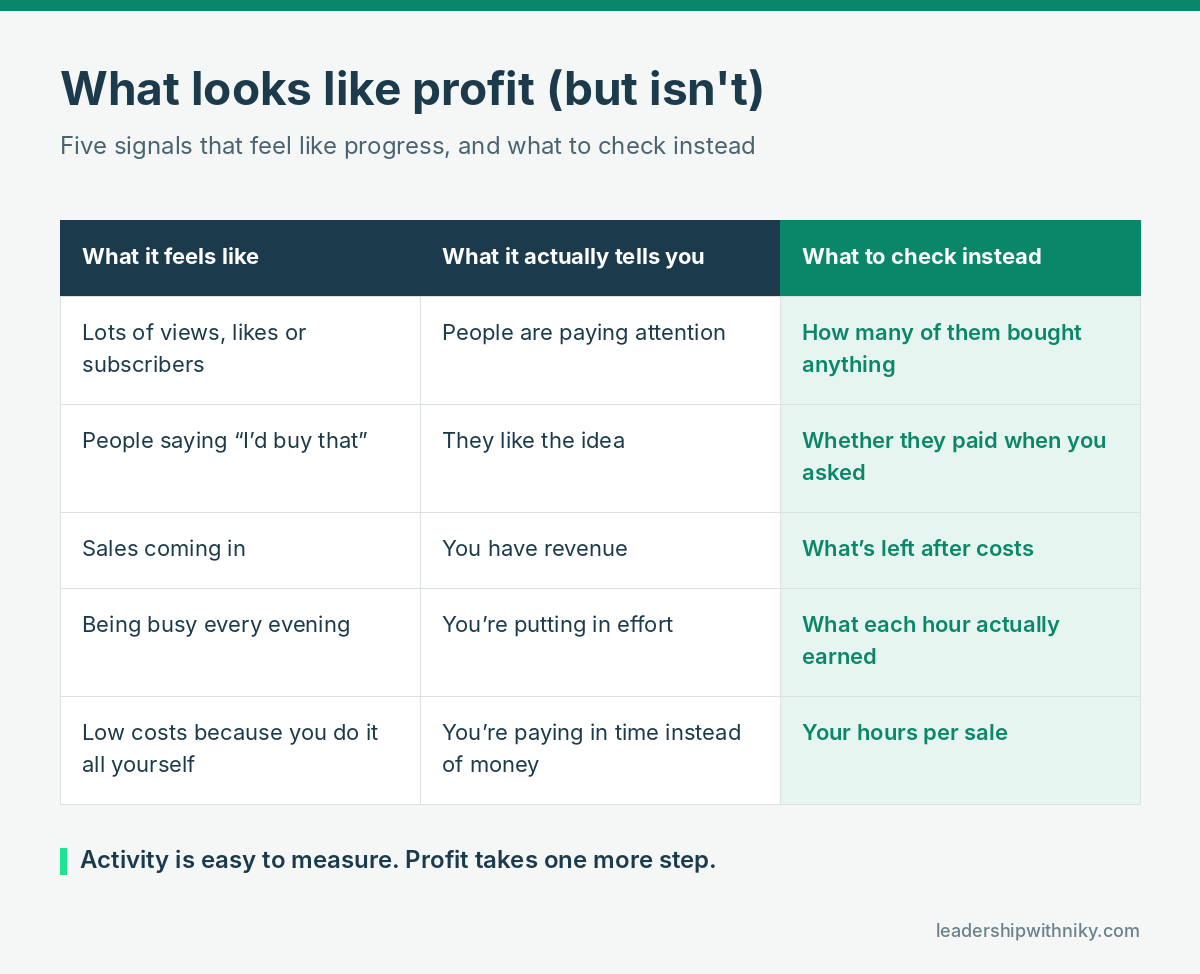
The signals that feel like profit are usually measures of attention or effort, not money left over. It's easy to mistake busy, popular or praised for profitable, especially after months of hard work.
What it feels like | What it actually tells you | What to check instead |
|---|---|---|
Lots of views, likes or subscribers | People are paying attention | How many of them bought anything |
People saying "I'd buy that" | They like the idea | Whether they paid when you asked |
Sales coming in | You have revenue | What's left after costs |
Being busy every evening | You're putting in effort | What each hour actually earned |
Low costs because you do it all yourself | You're paying in time instead of money | Your hours per sale |
My YouTube channel ticked the first and fourth rows for most of a year. Activity is easy to measure. Profit takes one more step, and it's the step that matters.
What's the first step to checking if your business idea is profitable?
This week, take one offer and write down four rough numbers: the price, the cost per sale, the hours per sale, and how many sales a month you could realistically make. It takes about 15 minutes and a notebook, and it's a starting point, not a verdict.
Then ask yourself one question: if this was all it earned, would I be happy with what each hour paid me? If the answer is no, you can change the price, cut the hours or choose a different offer before you've built a thing. If the answer is yes, that's your cue to test it properly with a full feasibility check, not your cue to start building.
If you're not sure which offer to check yet, start with how to turn the skills from your job into income. And if you're still deciding whether to build alongside your job at all, read my guide to starting a business while working full time.
Trust what you know. Then test it, numbers included.
FAQs: Knowing If a Business Idea Is Profitable
Q: How do I evaluate my business idea?
A: Evaluate it in two parts. First, check demand: will real people take an action like paying, booking or joining a waitlist? Then check feasibility: your market, pricing, costs and break-even point, starting with what each sale leaves after costs and your hours. An idea needs to pass both, and you can test each while you keep your job.
Q: What is a feasible business idea?
A: A feasible business idea is one you can actually deliver with the skills, time and money you have, that enough people will pay for, at a price that leaves a profit. If you have a full-time job, feasible also means it fits into a few protected hours a week rather than needing you every evening.
Q: Is it true that 90% of startups fail?
A: Not for small businesses in general. US Bureau of Labor Statistics data shows about 51% of private-sector businesses that opened in the year to March 2020 were still operating five years later, and about 35% of those from 2015 were still going after ten (BLS business survival data). Many close, but far fewer than 90%.
Q: Can you make money from an idea?
A: Not from the idea on its own. Money comes from an offer someone pays for, delivered for less than the price. Loved ideas like MoviePass still lost money. Start by turning your idea into one small paid offer, then check what each sale leaves you after costs and your time.
Know your numbers before you build
You don't need to be a finance person to check whether an idea will make money. You need honest numbers, a willingness to count your own time, and a proper feasibility check before you build.
I learned that the long way, about 500 hours of it. You can start with 15 minutes and a notebook, then test it properly before you commit your evenings.
If you're still working out which idea is worth checking, my free framework walks you through finding the business in the skills you already have, step by step, with a workbook and a video walkthrough.
👉 Get the free From Job to CEO Framework
Which offer could you run the four-number check on this week? Come and tell me in the free From Job to CEO community on Skool.