
Should I Quit My Job to Start a Business?
Should I quit my job to start a business? Not on a bad day. Here are the signs you're ready, what "not yet" should look like, and one step to decide.
Last updated: 6 November 2026
I think about quitting my job all the time. Not once a year. Most weeks.
Some days it's because I look at how much I get done on my business in evenings and lunch breaks, and wonder what I'd do with whole days. Other days it's because work is a lot, I'm juggling everything, and handing in my notice sounds like relief.
So should you quit your job to start a business? For most people, not yet. Quit when your business has replaced your income consistently for several months and you have savings to fall back on, not when you've had a bad week. Until then, "not yet" isn't a no. It's a plan.
Below are the signs you're ready, what quitting too early can cost, why your job might be your biggest advantage right now, and one step to help you decide.
Should I quit my job to start a business, or keep building on the side?
Keep building on the side until your business proves it can pay you, month after month. For most people that's the safer and faster route, because your job funds the experiments your business needs to find what works.
That's not just my opinion. Researchers Joseph Raffiee and Jie Feng at the University of Wisconsin-Madison studied people who kept their job while starting a business, which they called hybrid entrepreneurs, and found they were about a third less likely to fail than people who quit to start straight away. The study was published in the Academy of Management Journal in 2014 (The Globe and Mail's report on the hybrid entrepreneur study).
Keeping your job isn't the scared option. Often, it's the strategic one. Some people keep their job for good and build a business alongside it, and that's a valid outcome too.
Why do you keep wanting to quit your job, even when you know you're not ready?
You keep wanting to quit because the pull is usually a feeling, and feelings show up on hard days, not when your business is ready. A frustrating meeting, a long week or a missed school event can make quitting feel urgent, even when nothing has changed in your business.
I know this one well. I nearly quit in my head on a regular basis. What keeps me here for now is that I already know my gap: the difference between what my business earns today and what it would need to earn to replace my salary. I'm realistic about it, and it isn't closed yet.
There's a useful question to ask on those days. Are you running towards your business, or running away from your job? Both are real. But only one of them is a reason your business is ready.
If it's mostly the job, the fix might be protecting your energy at work first, not leaving it. I wrote about that in how to stop your job draining your energy without quitting.
What are the signs you're ready to quit your job to start a business?
You're ready to quit when your business has replaced your income consistently, you have savings to live on, and you're leaving for the business rather than away from the job. One good month or one exciting launch isn't enough.
Foundr's guide on when to quit your job lists similar signs: healthy income from the side business, a cash cushion, a proven business model, a plan and emotional readiness. It also suggests keeping at least six months of living costs in reserve (Foundr's guide to when to quit your job).
My own line is simple, and a bit boring. I want three to six months of living costs saved, and at least three months in a row where my business has replaced my salary. Not one month. Three, back to back. That's my rule for my situation, not financial advice for yours.
"Replaced my salary" is a bigger number than most people expect, because your job pays for more than what lands in your bank account. If you want to know exactly what yours is. From Salary to Sales works out how much your business needs to make before you quit.
Ready to quit | Not yet (keep building) | |
|---|---|---|
Income | Your business has replaced your income for at least three months in a row | Sales are growing, but they come in bursts |
Savings | You have several months of living costs set aside | One quiet month would put pressure on your bills |
Evidence | You know which offer sells and how people find you | You're still testing what works |
Reason | You're excited about what's next | You're mostly fed up with your job |
Pressure | You could have a slow month without panicking | Every sale has to pay a bill |
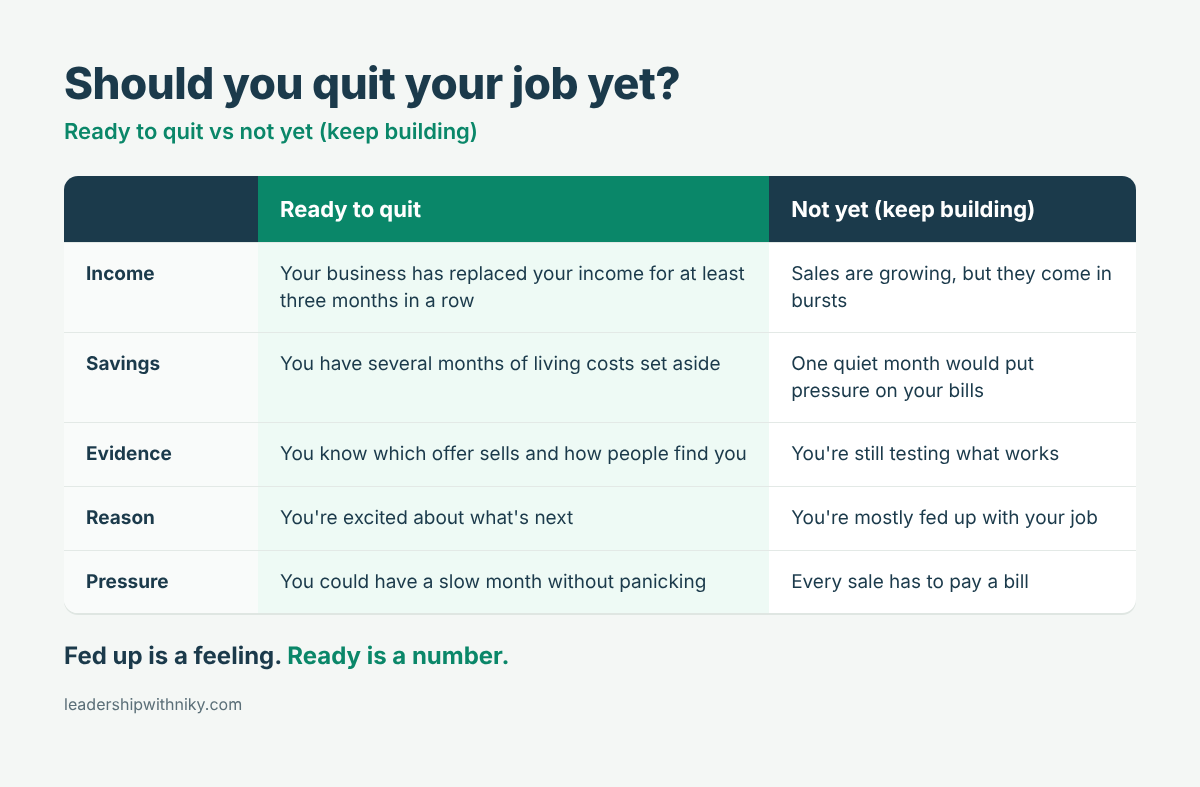
If most of your answers sit in the right-hand column, that's not failure. It's your to-do list.
What happens when you quit your job before your business is ready?
When you quit before your business can pay you, the pressure to earn money fast can take over every decision you make. The business stops being something you're building and becomes something that has to pay the bills by Friday.
I watched this happen to someone I know. They got so frustrated with their job that they quit and went all in. Four months later, they were looking for a job again, because the business hadn't yet found steady, repeatable income.
What struck me most was what happened in between. Those four months turned into a spiral of chasing money. When you're panicking about where the next dollar is coming from, it's very hard to step back and see the bigger picture. Every decision was about this month, not about what would actually grow the business.
If money is the part you're unsure about, I've written up how much your business should make before you quit, including what your job quietly pays for that most people forget to count.
Why is keeping your job an advantage while you build your business?
Your job takes the panic out of building a business, and panic makes for bad decisions and pushy selling. While my salary covers the bills, my business doesn't have to be the breadwinner yet, and that changes how I build it.
In my own business, it means I can pay to test things that might speed it up: a small ad test, a course that moves me forward, an automation that saves me evenings. I can take a risk that might not pay off, because one failed experiment doesn't put dinner at risk. I walk through how I set those tests up in how to test a business idea in 30 days without quitting.
It also means I never have to sell from a place of need. I don't like being sold to hard, and I don't want to be that person. I want every sale to be a win for both of us, with someone who's genuinely happy with what they bought. Without the pressure, I can wait for that.
And if I need to step back for a couple of weeks and think something through, I can. Nothing falls over.
What's the downside of keeping your job while you build?
The real cost of staying employed is time: you'll have fewer hours for your business, and progress will feel slower than you want. That's the honest trade-off, and it's worth naming rather than pretending the hybrid path is perfect.
I don't have whole days to spend on my business. I work in protected pockets, like lunch breaks and evenings after the kids are in bed, and I don't always have the space to step back and see everything I might see with more capacity.
But I've made my peace with the trade. Slower progress without panic beats faster progress with it, at least for me. And I genuinely love the time I do spend on my business, partly because none of it is desperate.
If those evening pockets feel impossible right now, here's how to work on your business when you're tired after work.
What if you hate your job but you're not ready to quit?
If you hate your job but your business isn't ready, change what you can at work and give "not yet" a shape, so it doesn't become years of waiting. A "not yet" with no end point is just a holding pattern.
One important exception first.If your job is harming your health, that's a separate and more urgent conversation. Talk to your doctor or someone you trust, and remember that your health matters more than any business plan. This post is general guidance, not medical or financial advice.
For everyone else, "not yet" should have three things: your gap written down, one 30-day experiment working on closing it, and a date to check your numbers again. That turns the waiting into building.
The full step-by-step guide to doing this alongside a job is in my guide to starting a business while working full time.
What's the first step to deciding whether to quit your job to start a business?
The first step is writing down three numbers, so the decision is based on evidence instead of your mood that day. It takes about 20 minutes and you only need your bank statements and a notebook.
What your business made in each of the last three months.Write each month separately, not an average. You're looking for consistency, not one good month.
What it needs to make each month to replace your income. Use your pay before tax, plus what your employer pays on top. If you want this worked out properly, From Salary to Sales calculates your real quit number.
How many months of living costs you have saved. Count the essentials, not your current lifestyle.
Then look at the gap between number one and number two. That gap is your answer for now. It tells you whether you're quitting soon, or what to build next.
Trust what you know. Then test it.
FAQs: Should I Quit My Job to Start a Business?
Q: Is it worth quitting your job to start a business? A: It can be, once the business has proven it can pay you consistently. Quitting early mostly adds pressure. Research by Raffiee and Feng (2014) found people who kept their job while starting a business were about a third less likely to fail. For many people, building alongside a job is the stronger first step.
Q: What are the signs it's time to quit my job? A: The clearest signs are several months in a row of business income that replaces your salary, savings to live on, and knowing which offer sells and how people find you. Wanting to leave a frustrating job is real, but on its own it's a reason to change things at work, not proof your business is ready.
Q: How much money do I need to quit my job and start a business? A: You need two numbers: monthly business income that covers your pay before tax, what your employer adds on top and your business costs, plus savings to live on while things settle. Foundr suggests at least six months of living costs. This is general guidance, not financial advice, so check your own situation.
Q: Is $20,000 enough to start a business? A: If you start while you're still employed, you'll often need far less, because your job covers your living costs while you test. The amount matters less than proof that people will pay. Start small, test one offer and spend more only on what's working. Talk to a financial adviser before using savings.
"Not yet" is a plan, not a no
You don't need to quit on a bad day, and you don't need to stay forever. Know your gap, build while your job pays the bills, and leave when the numbers say it's time and you're excited about what's next.
Fed up is a feeling. Ready is a number.
If you're still working out which business to build in the meantime, my free framework walks you through finding the business hiding in the skills and experience you already have, with a workbook and a video walkthrough.
👉Get the free From Job to CEO Framework
What's the one thing that would tell you it's time to quit? Come and tell me in the free From Job to CEO community on Skool.